WhatsApp Marketing for Beauty Shopify Brands
TL;DRWhatsApp marketing for beauty Shopify brands works best when it follows the customer's product cycle. A moisturizer runs out. A serum needs time before the customer can judge results. A shade match question needs a real reply. A VIP buyer may care more about early access than another discount.
That is why beauty brands should not copy a generic WhatsApp campaign calendar. The better model is a retention system built around replenishment, education, reviews, VIP moments, product recommendations, and winback.
This guide shows how beauty and skincare stores can use WhatsApp without turning a personal channel into a noisy promotional list.
Why Beauty Stores Need A Different WhatsApp Plan
Beauty buyers often need more context than a simple product reminder. They may compare ingredients, skin concerns, shades, routines, bundles, subscription timing, and social proof before ordering again.
That creates three practical differences for WhatsApp marketing:
| Beauty reality | What it means for WhatsApp |
|---|---|
| Products have usage cycles | Reorder timing should follow expected depletion, not a fixed monthly blast |
| Results take time | Review requests and before-after prompts need a realistic use window |
| Questions are personal | Replies about skin type, shade, sensitivity, or routine should route to support when needed |
| Product fit matters | Campaigns should segment by category, concern, shade, bundle, and purchase history |
| Trust is fragile | Over-sending discounts can damage the brand and the channel |
For a beauty Shopify store, WhatsApp should feel like timely help from the brand, not a generic sale alert.
The Beauty WhatsApp Flow Map
Start by separating campaigns by customer moment.
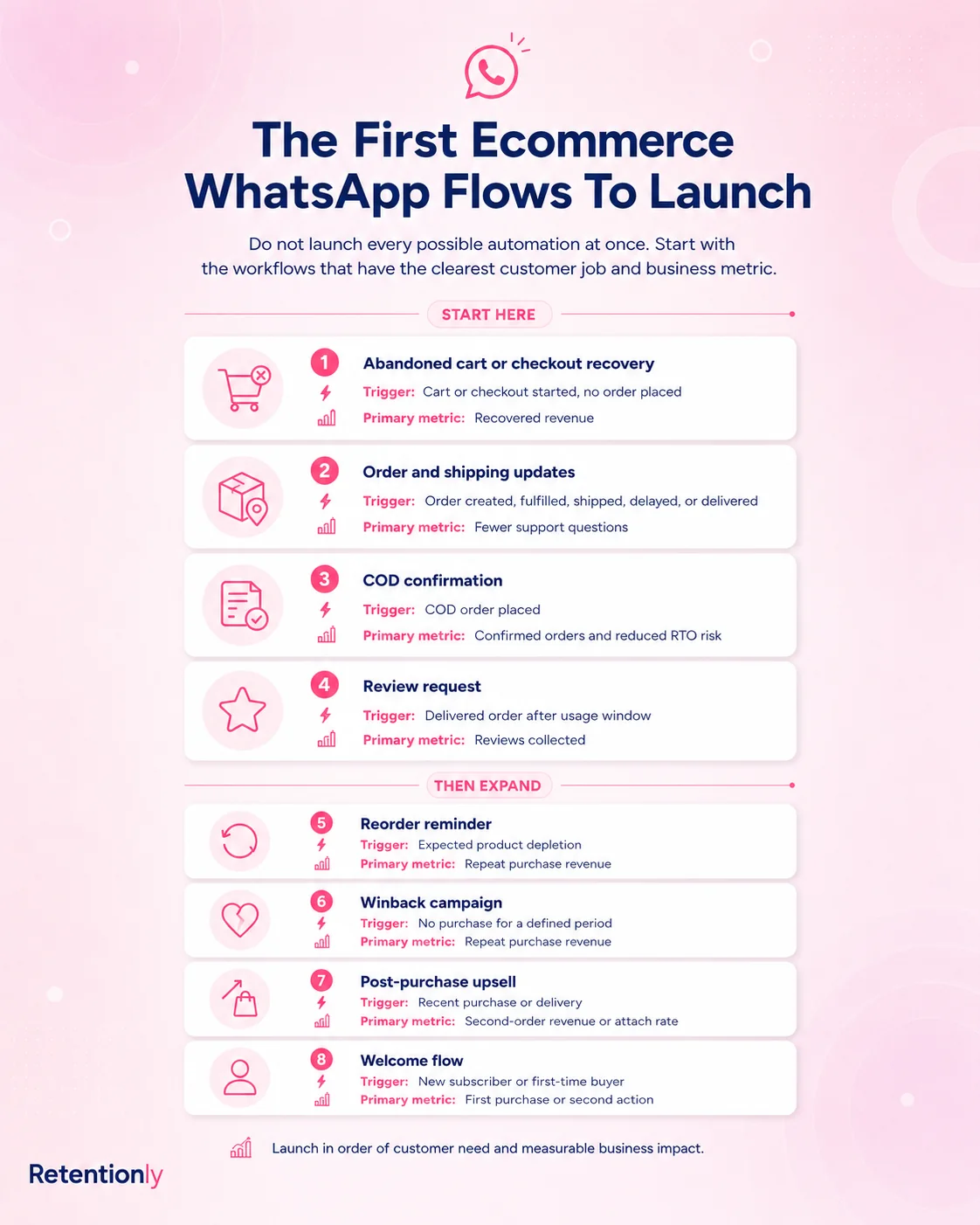
| Flow | Best beauty use | Trigger | Primary metric |
|---|---|---|---|
| Abandoned checkout | Help shoppers return to a saved routine, kit, or shade | Checkout started, no order placed | Recovered revenue |
| Product education | Help the buyer use the product properly | Delivered order or product-specific delay | Repeat purchase readiness and fewer support questions |
| Review request | Ask after the customer has had time to try the product | Delivery plus usage window | Reviews collected and review quality |
| Replenishment reminder | Nudge refill before the product runs out | Expected depletion window | Repeat purchase revenue |
| Cross-sell | Recommend a logical routine companion | Purchase or delivery milestone | Second-order revenue |
| VIP or launch | Give early access to high-intent segments | New drop, bundle, or limited inventory | Launch revenue per recipient |
| Winback | Bring back inactive buyers with a relevant reason | No purchase after expected cycle | Repeat purchase revenue |
This order is not fixed. A refill-heavy skincare brand may start with replenishment. A makeup brand with frequent drops may prioritize VIP and back-in-stock alerts. A beauty brand with weak social proof may build review requests earlier.
The rule is simple: launch the flow with the clearest customer signal first.
Segment By Product Use, Not Just Spend
Many beauty teams segment only by total spend or last purchase date. That is useful, but it misses why the customer bought.
Better WhatsApp segments include:
| Segment | Good WhatsApp angle |
|---|---|
| Cleanser buyers | Refill reminder, matching moisturizer, routine education |
| Serum buyers | Usage tips first, review request after a longer trial window |
| Makeup shade buyers | Back-in-stock by shade, complementary product, application tips |
| Fragrance buyers | Discovery sets, gifting reminders, VIP launches |
| Bundle buyers | Routine replenishment, subscription prompt, product-order guidance |
| First-time buyers | Welcome, usage help, review request, second-product nudge |
| Repeat buyers | Refill, loyalty, early access, higher-value bundles |
| Lapsed category buyers | New arrivals, improved formula, controlled winback offer |
Do not send the same message to a cleanser buyer, lipstick buyer, fragrance buyer, and gift buyer just because they all bought from the store. Beauty retention depends on product context.
Flow 1: Abandoned Checkout For Beauty Products
Beauty abandoned checkout messages should reduce hesitation. The shopper may be unsure about shade, ingredient fit, routine order, shipping time, or whether the product is right for their skin concern.
Use a first reminder that helps the customer finish without pressure.
| Component | Practical setup |
|---|---|
| Audience | Opted-in shoppers with a saved checkout |
| Timing | 30 to 60 minutes after checkout abandonment |
| Message job | Bring the shopper back and invite product questions |
| Suppression | Stop after purchase, opt-out, support issue, or final reminder |
| Metric | Recovered revenue, replies, conversion, opt-outs |
Example:
Hi [first_name], your [store_name] checkout is still saved. You can complete it here: [checkout_link]. Reply if you want help choosing the right shade or routine.
Use discounts carefully. For beauty, reassurance, shade help, ingredient answers, or social proof may work better than training every shopper to wait for a coupon.
For the full checkout flow, read the Shopify Abandoned Checkout WhatsApp Guide.
Flow 2: Post-Purchase Education
Education is one of the most underused WhatsApp flows for beauty. It can reduce confusion, improve product experience, and prepare the next purchase without immediately selling again.
Use it for products that need instructions:
| Product | Useful education message |
|---|---|
| Serum | When to apply, how often, and what to avoid mixing |
| Skincare kit | Morning or night routine order |
| Hair treatment | Application steps and expected usage frequency |
| Fragrance | Storage, layering, and sample discovery |
| Makeup | Shade tips, application guide, and removal care |
Example:
Your [product_name] has arrived. For best results, start with [usage_tip] and use it [frequency]. Here is the quick routine guide: [guide_link]
Do not hide an aggressive offer inside the first education message. The first job is product success. A later cross-sell can work only after the customer has enough usage context.
Flow 3: Review Requests With Real Use Windows
Beauty reviews are strongest when the customer has had time to judge the product. Asking too soon can produce shallow feedback or avoidable negative replies.
Use product-specific review windows:
| Product type | Better review timing |
|---|---|
| Makeup, accessories, tools | 3 to 7 days after delivery |
| Fragrance | 5 to 10 days after delivery |
| Skincare basics | 10 to 21 days after delivery |
| Treatment products | After the minimum trial window your brand can support |
| Gift orders | Ask the buyer for shopping experience feedback, not product-result feedback |
Example:
Hi [first_name], hope [product_name] has been part of your routine for a bit now. Could you leave a quick review for [store_name]? It helps other shoppers choose with confidence: [review_link]
Suppress refunded orders, delivery failures, open complaints, replacement orders, and customers who already reviewed. If the customer replies with a product issue, route that conversation to support before sending another review reminder.
For Shopify-specific review timing, read the Shopify Review Request WhatsApp Flow Guide.
Flow 4: Replenishment Reminders
Replenishment is often the best beauty retention use case because the message can match a real need.
The trigger should be based on product size, expected use, and customer history.
| Product cycle | Reminder timing |
|---|---|
| 15-day mini or trial size | Day 11 to 14 |
| 30-day product | Day 24 to 28 |
| 45-day product | Day 38 to 42 |
| 60-day product | Day 50 to 56 |
| Irregular product | Use customer history or skip the flow |
Example:
Running low on [product_name]? You can reorder your [store_name] refill here in one tap: [reorder_link]
If the customer bought a starter kit, the refill message should point to the right individual products. If they bought a shade or scent, the message should preserve that variant. If they switched product families, update the segment instead of sending stale refill prompts.
For more examples, read the WhatsApp Reorder Reminder Message Guide.
Flow 5: Cross-Sells And Routine Builders
Beauty cross-sells should feel like routine help. Random recommendations are easy to ignore.
Better cross-sell logic:
| Purchase | Better recommendation |
|---|---|
| Cleanser | Moisturizer, sunscreen, or routine kit |
| Serum | Compatible moisturizer or sunscreen |
| Lipstick | Matching liner, remover, or shade bundle |
| Fragrance sample | Full-size bottle or discovery set |
| Hair product | Treatment, refill, or styling companion |
Example:
Many customers pair [product_name] with [recommended_product] for [specific_benefit]. You can see the routine here: [product_link]
Wait until the recommendation makes sense. Some beauty products can be paired immediately after purchase. Others should wait until after delivery or usage education.
For a broader upsell structure, read Shopify Post Purchase Upsell WhatsApp Flow Guide.
Flow 6: VIP Offers, Drops, And Back-In-Stock Alerts
Beauty brands often have launches, limited drops, shade restocks, influencer collections, festive bundles, and VIP access windows. WhatsApp can work well here because the message is timely.
Do not send every launch to every contact.
| Campaign | Best audience |
|---|---|
| New skincare drop | Buyers of related concerns or routines |
| Shade restock | Customers waiting for that shade or similar products |
| VIP bundle | Repeat buyers, high-value customers, loyalty members |
| Fragrance launch | Sample buyers, past fragrance buyers, gift buyers |
| Seasonal offer | Category buyers with prior seasonal interest |
Example:
[first_name], [shade_name] is back in stock. Since you asked for updates, you can shop it here before the wider announcement: [product_link]
The message should explain why the customer received it. "You bought this category", "you asked for this restock", or "you are in the VIP group" feels better than a broad sale blast.
Flow 7: Beauty Winback
Winback works when the inactivity window matches the category. A customer who bought a 30-day cleanser may be lapsed after 45 days. A fragrance buyer may not be lapsed for months.
Use different winback rules:
| Segment | Winback angle |
|---|---|
| Refill buyer overdue | Reorder prompt with the exact product |
| Skincare buyer inactive | Routine refresh or product education |
| Makeup buyer inactive | New shade, look, or seasonal collection |
| Fragrance buyer inactive | Discovery set, gifting, or new scent launch |
| VIP buyer inactive | Early access or concierge-style help |
Example:
Hi [first_name], we added new [category_name] picks since your last [store_name] order. You can see them here: [collection_link]
Avoid monthly "we miss you" messages to the same non-responders. If a customer ignores the first winback sequence, widen the window, change the angle, or suppress them from future promotional WhatsApp sends.
Consent, Templates, And Sensitive Replies
Beauty brands should be careful with WhatsApp consent and reply handling.
A checkout phone number is not automatically permission for promotional WhatsApp marketing. Your opt-in should say what the customer is signing up for, such as order updates, product tips, refill reminders, offers, or launches.
Business-initiated messages outside the customer service window may need approved templates. Build templates around real jobs:
| Template job | Example use |
|---|---|
| Cart recovery | Saved checkout reminder |
| Refill reminder | Product-specific reorder nudge |
| Review request | Ask after delivery and usage window |
| Back-in-stock | Alert for a requested shade or product |
| VIP launch | Early access to a relevant drop |
| Winback | Category-specific return prompt |
Also define reply routing. If someone mentions irritation, allergy, reaction, refund, delayed delivery, wrong item, or shade mismatch, pause promotional flows and move the conversation to support.
This is both practical and brand-protective. Beauty conversations can become personal quickly, so the automation should know when to stop selling.
Frequency And Suppression Rules
WhatsApp frequency should be controlled across all beauty flows, not separately inside each campaign.
Use these suppression rules:
Stop abandoned checkout messages after purchase.
Pause promotional sends during an open support issue.
Exclude refunds, cancellations, and replacements from review requests.
Do not send refill reminders after the customer already reordered.
Suppress customers waiting for a different shade or variant.
Exclude recent purchasers from broad discounts.
Limit promotional messages in a defined period.
Respect opt-outs before the next campaign send.
The customer does not care that your review flow, refill flow, and launch campaign live in different tools. They experience all of them as one brand relationship.
What Beauty Brands Should Measure
Measure WhatsApp by flow, not by sends.
| Flow | Primary metric | Guardrail |
|---|---|---|
| Abandoned checkout | Recovered revenue | Opt-outs and discount use |
| Education | Fewer support questions or stronger repeat purchase readiness | Confused replies |
| Review request | Reviews collected | Negative replies and rating quality |
| Replenishment | Repeat purchase revenue | Too-early or too-late timing |
| Cross-sell | Second-order revenue | Irrelevant recommendations |
| VIP launch | Revenue per recipient | Over-messaging best customers |
| Back-in-stock | Restock conversion | Wrong shade or stockout sends |
| Winback | Repeat purchase revenue | Offer cost and opt-outs |
Clicks alone are not enough. A beauty WhatsApp program should improve repeat purchase behavior, product confidence, customer experience, and review volume without increasing complaints.
Where Retentionly Fits
Retentionly is built for Shopify teams that want WhatsApp marketing tied to store events and retention revenue.
For beauty brands, that means you can plan flows around abandoned checkout, delivery, product use windows, review timing, replenishment, winback, VIP segments, and customer replies. The point is not to send more messages. The point is to make every message match a real customer moment.
Use Retentionly when you want:
Shopify-triggered WhatsApp automations.
Customer segments based on purchase history and lifecycle stage.
Replenishment, review, winback, upsell, and abandoned checkout flows.
Suppression rules for purchases, opt-outs, support issues, and completed flows.
Revenue tracking around recovered and repeat purchases.
For broader strategy, read the WhatsApp Marketing for Ecommerce Guide and the WhatsApp Campaign Ideas for Shopify Stores.
Final Recommendation
Build beauty WhatsApp marketing around product experience first.
Start with one high-intent flow: abandoned checkout, review request, or replenishment. Add education where product success matters. Add cross-sells only when the recommendation is obvious. Use VIP, launch, and back-in-stock messages for customers who have a clear reason to care.
Before every send, answer six questions: who should receive this, why now, what product context matters, what should the message do, when should it stop, and what proves it worked?
That is how beauty Shopify brands turn WhatsApp into a retention channel instead of another promotional blast.
Install Retentionly free on Shopify to launch WhatsApp marketing flows for beauty replenishment, reviews, abandoned checkout recovery, VIP campaigns, winback, and repeat purchases.