Shopify Post Purchase Upsell WhatsApp Flow Guide
TL;DRShopify post-purchase upsell flows on WhatsApp work best when they continue the purchase the customer just made. The goal is not to interrupt the buyer with a random discount after checkout. The goal is to recommend a relevant add-on, upgrade, refill, bundle, or next product while the customer still understands why it fits.
That distinction matters. A customer who just bought a camera may appreciate a lens, memory card, or care kit. A customer who bought skincare may appreciate the matching serum after delivery. A customer who bought one bag of coffee may need a reorder reminder later, not an immediate upsell. The timing and recommendation should follow the product relationship.
For Shopify merchants, WhatsApp can be useful because post-purchase moments are time-sensitive and personal. But it also needs restraint. This guide shows how to build a post-purchase upsell flow around Shopify order data, product logic, stop rules, and measurable revenue instead of turning every order into a generic sales blast.
What A Post-Purchase WhatsApp Upsell Should Do
A post-purchase upsell is an automated message sent after a customer places an order, receives an order, or reaches a relevant post-purchase moment. It recommends something that improves the original purchase or moves the customer to a stronger next step.
It should answer six practical questions:
| Flow part | Decision to make | Strong default |
|---|---|---|
| Trigger | What starts the flow? | Paid Shopify order, fulfilled order, or delivered order |
| Audience | Which customers should enter? | Customers with WhatsApp consent and a clean order status |
| Recommendation | What should be offered? | Add-on, upgrade, bundle, subscription, or complementary product |
| Timing | When should it send? | Based on fulfillment stage, delivery, product use, and buyer intent |
| Stop rule | What cancels the message? | New order, refund, cancellation, support issue, opt-out, or prior upsell purchase |
| Metric | What proves it worked? | Upsell conversion, revenue per recipient, AOV lift, and opt-outs |
The strongest upsell flows feel like useful next steps. The weakest ones feel like the store is trying to monetize the customer again before the first order has even been fulfilled.
Upsell, Cross-Sell, Reorder, And Winback Are Different
Do not use one post-purchase flow for every retention goal.
| Flow | Best use | Example |
|---|---|---|
| Upsell | Move the customer to a higher-value version or bundle | "Upgrade to the larger kit before your order ships" |
| Cross-sell | Recommend a complementary product | "Add the care kit that pairs with your shoes" |
| Reorder reminder | Bring the customer back when a consumable may run out | "Your 30-day supplement pack may be almost finished" |
| Winback | Re-engage a customer after they become inactive | "It has been a while since your last order" |
Post-purchase upsell is closest to the original order. It should use what the customer just bought to make the next offer more relevant.
That is why this flow should not copy an abandoned checkout sequence. The customer already purchased. The tone should be helpful, appreciative, and specific to the order, not urgent in the same way a cart recovery message is urgent.
Choose The Right Upsell Moment
Timing is the most important decision in this workflow. Send too early and the message can feel like pressure. Send too late and the original purchase context is gone.
Use the order stage to choose the moment:
| Timing | Best for | Avoid when |
|---|---|---|
| 15-30 minutes after order | Simple add-ons that can ship with the original order | Fulfillment is already too fast or the customer may feel interrupted |
| 3-6 hours after order | Complementary products with a clear reason | The offer needs product usage experience first |
| Before fulfillment cutoff | Add-ons that can be packed with the current order | Warehouse operations cannot reliably merge orders |
| After fulfillment | Products that do not need to ship together | The customer may still be waiting anxiously for the first order |
| After delivery | Accessories, care products, refill bundles, reviews plus offer | Delivery tracking is unreliable or the item needs longer use |
| After product usage window | Refills, replacements, routines, and bundles | The product is not consumable or repeatable |
For a first version, choose one timing rule and one product family. A store selling footwear might test a care-kit cross-sell after delivery. A beauty store might send a complementary serum offer two days after delivery. A food brand might wait until the customer has had time to try the product before suggesting a bundle.
Build Recommendation Logic Before Writing Copy
The recommendation decides whether the message feels personal.
Useful Shopify rules include:
| Rule | Why it matters |
|---|---|
| Product or variant purchased | Keeps the offer tied to the customer's actual order |
| Collection or product type | Lets you group related products without writing a flow for every SKU |
| Cart value or order value | Helps avoid low-margin offers on small orders |
| Quantity purchased | Prevents offering the same add-on when the customer already bought enough |
| Product already purchased | Stops the flow from recommending something the customer already owns |
| Subscription status | Avoids promoting a one-time upsell to active subscribers |
| Fulfillment and delivery status | Keeps the timing aligned with the customer experience |
| Return, refund, or cancellation status | Suppresses messages when the order has a problem |
This is where Shopify context matters. A generic WhatsApp broadcast can send a coupon. A useful post-purchase upsell flow needs to understand the order, the product relationship, and whether the customer is still eligible.
Match The Offer To The Order
The right offer depends on what the customer bought and what would genuinely improve the purchase.
| Customer just bought | Better WhatsApp offer | Why it works |
|---|---|---|
| Entry-level product | Upgrade or premium bundle | The customer has shown category intent |
| Main product without accessory | Complementary add-on | The add-on improves use of the original product |
| Single item in a routine | Kit or bundle | It makes the routine easier |
| Consumable product | Refill pack or subscription invitation | It matches repeat purchase behavior |
| Giftable item | Gift wrap, note, or second gift suggestion | It supports the buying occasion |
| High-value item | Care, warranty, protection, or concierge help | It protects the original purchase |
| Seasonal product | Relevant next seasonal item | It continues the shopping context |
Avoid offers that only help the store. "Buy more because we want a higher AOV" is not a customer reason. The customer reason might be convenience, better results, a complete set, faster setup, lower shipping friction, or a limited window to add something before fulfillment.
Write Messages That Continue The Purchase
WhatsApp upsell copy should be short, specific, and easy to act on. Mention the original order context, explain the fit, and give one clear action.
Add-On Before Fulfillment
Hi [first_name], thanks for your order from [store_name].
>
Many customers add [addon_name] with [product_name] because it helps with [benefit].
>
If you want it shipped together, you can add it here before we pack your order: [product_link]
>
Reply STOP to opt out.
Use this only when the operations team can reliably handle the extra order or merged shipment. If fulfillment is already moving, do not promise combined shipping.
Cross-Sell After Delivery
Hi [first_name], hope your [product_name] arrived safely.
>
If you want to get more from it, [addon_name] pairs well because [specific_reason].
>
You can see it here: [product_link]
>
Reply STOP to opt out.
This works well for accessories, care products, complementary items, and setup products.
Bundle Upgrade
Hi [first_name], quick note about your [product_name] order.
>
If you are planning to use it regularly, the [bundle_name] may be better value than buying items one by one.
>
Here is the bundle: [bundle_link]
>
Reply STOP to opt out.
This is useful when the bundle has a clear value story. Do not use it for unrelated product bundles.
Subscription Or Repeat Purchase Offer
Hi [first_name], if [product_name] becomes part of your routine, you can set up an easy repeat order and avoid running out.
>
Start here: [subscription_or_reorder_link]
>
Reply STOP to opt out.
Use this after the customer has enough time to try the product. If the product has not arrived yet, a subscription push can feel premature.
Use Stop Rules Aggressively
Post-purchase upsell flows need strong stop rules because they happen close to customer service moments.
Stop the flow when:
The customer places another order.
The original order is canceled, refunded, returned, or failed.
The customer already bought the recommended product.
The customer is in an active abandoned checkout, COD confirmation, review request, reorder, or support flow.
The customer opts out or replies negatively.
The customer has an unresolved delivery issue or support ticket.
The product is out of stock or the offer link is no longer valid.
Priority matters. If a customer's order is delayed, order support should win over an upsell. If the customer starts a new checkout, abandoned checkout recovery should win. If the customer buys the add-on, the upsell flow should stop immediately.
Keep Compliance And Customer Expectations Clear
Post-purchase upsells are promotional messages. Treat them like marketing, not transactional order updates.
Practical rules:
Only send to customers who have given appropriate consent for WhatsApp marketing.
Make the brand name clear.
Use approved templates where required.
Keep the message expected, relevant, and tied to the order context.
Include a clear opt-out path such as "Reply STOP to opt out."
Do not bundle marketing consent with transactional order updates in a confusing way.
Respect opt-outs across WhatsApp and other consent collection points.
The safest operating principle is simple: if the message promotes another purchase, the customer should have expected that kind of WhatsApp message.
Measure More Than Revenue
Upsell revenue matters, but it is not the only metric.
Track:
| Metric | Why it matters |
|---|---|
| Upsell conversion rate | Shows whether the offer is relevant |
| Revenue per recipient | Helps compare offers and segments |
| AOV lift | Shows whether the flow expands order value |
| Time to second purchase | Shows whether the flow accelerates retention |
| Opt-out rate | Reveals whether timing or relevance is wrong |
| Reply sentiment | Shows whether customers find the message helpful |
| Support tickets after message | Catches confusion or fulfillment promises that create work |
| Margin after discount | Prevents revenue growth from hiding weak profitability |
Do not judge the flow only by gross sales. A high-discount upsell can produce revenue while lowering margin and increasing opt-outs. A lower-volume, high-fit offer can be healthier if it creates repeat buyers without damaging trust.
Common Mistakes To Avoid
The biggest mistake is sending one generic offer after every order.
Other common mistakes include:
Sending an upsell before the customer receives enough value from the first purchase.
Recommending products the customer already bought.
Offering a discount when the product fit should be enough.
Promising combined shipping when the operations team cannot support it.
Sending multiple post-purchase messages from different flows at the same time.
Treating upsell, reorder, and winback as the same campaign.
Ignoring refunds, delivery issues, and support status.
Measuring revenue without opt-outs, margin, or customer experience signals.
The fix is not a longer message. The fix is better flow logic.
How Retentionly Fits
Retentionly is built for Shopify WhatsApp retention workflows, so a post-purchase upsell flow can be planned around real store events instead of static lists.
A practical Retentionly setup should let a Shopify team:
Start the flow from a Shopify order, fulfillment, or delivery moment.
Segment by product, collection, order value, and customer history.
Suppress customers with refunds, cancellations, recent orders, or opt-outs.
Send approved WhatsApp templates for promotional messages.
Track revenue from the flow instead of only message delivery.
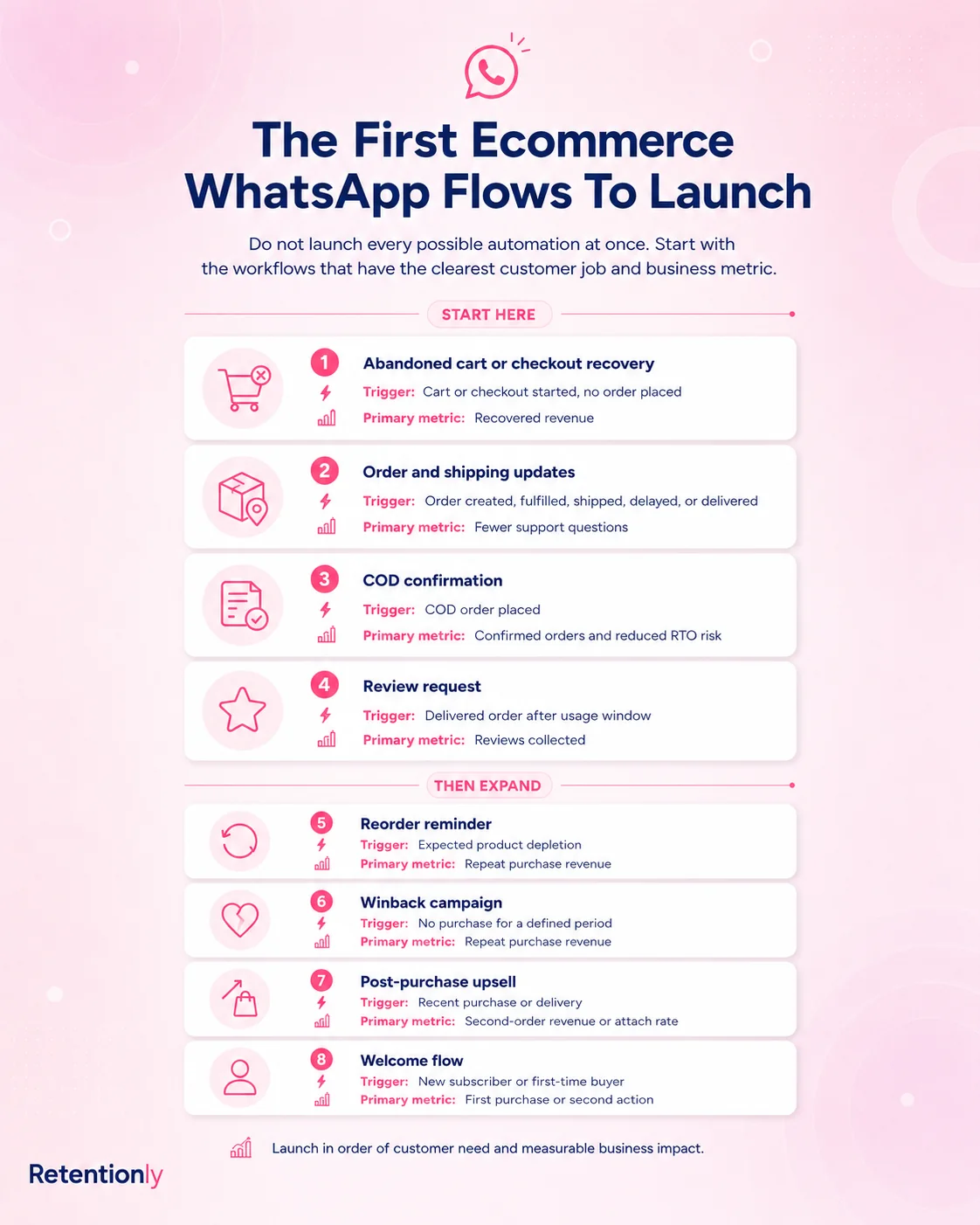
Launch related lifecycle flows such as abandoned checkout recovery, order updates, reviews, winback, and reorder reminders.
That matters because post-purchase upsell is not a standalone trick. It works best as part of a clean lifecycle system where each customer receives the next most relevant message.
A Simple First Flow To Launch
Start with one product family and one offer.
| Step | First-version choice |
|---|---|
| Trigger | Delivered order |
| Audience | Customers who bought a specific product or collection |
| Offer | One complementary product or bundle |
| Timing | 1-3 days after delivery |
| Message | Short WhatsApp template with product context and one link |
| Stop rule | Stop on purchase, opt-out, refund, return, support issue, or product already owned |
| Metric | Revenue per recipient, conversion rate, opt-out rate, and support replies |
After the first flow has data, add variants by product category, customer value, and order type. Do not start with ten flows. Start with one useful recommendation, prove it works, then expand.
Final Takeaway
A Shopify post-purchase upsell WhatsApp flow should make the customer's recent order more valuable. It should not feel like a second checkout pressure campaign.
Use Shopify order context, choose the right moment, recommend a product that genuinely fits, and stop the flow when the customer's situation changes. That is how WhatsApp becomes a retention and revenue expansion channel instead of another place to send generic promotions.
Ready to launch Shopify WhatsApp upsell flows with cleaner targeting and revenue tracking? Install Retentionly free on Shopify and start with one post-purchase workflow.