WhatsApp Marketing for Ecommerce: A Retention-First Guide
TL;DRWhatsApp marketing for ecommerce should start with retention, not volume. The channel is too personal to treat like a louder email list, and ecommerce teams usually have better signals than a generic broadcast calendar: cart intent, order status, delivery, product use, purchase cycle, category preference, and inactivity.
That is the real advantage. A customer who abandoned checkout needs a saved cart link. A customer waiting for delivery needs reassurance. A buyer who is likely running out of a consumable product needs a timely reorder path. A lapsed customer needs a relevant reason to come back.
This guide shows how ecommerce brands can build WhatsApp marketing around lifecycle revenue first, then add segmented campaigns and broadcasts once the foundation is working.
What WhatsApp Marketing Means For Ecommerce
For an ecommerce brand, WhatsApp marketing means using WhatsApp messages to move customers through buying, post-purchase, and repeat-purchase moments.
That includes:
Recovering abandoned carts and checkouts.
Sending useful order, shipping, and delivery updates.
Confirming COD orders before fulfillment.
Asking for reviews after delivery.
Welcoming new subscribers.
Recommending relevant upsells and cross-sells.
Sending reorder reminders for replenishable products.
Winning back inactive customers.
Announcing launches, back-in-stock alerts, price drops, and VIP offers.
The difference between good WhatsApp marketing and generic bulk sending is context. A strong message answers a customer moment. A weak message asks every contact to care about the same promotion at the same time.
Why Ecommerce Brands Should Start With Retention
Most ecommerce teams already spend heavily to acquire traffic. WhatsApp becomes more valuable when it helps more of that demand turn into repeat revenue.
Use WhatsApp where timing and customer context matter:
| Revenue moment | Customer signal | Better WhatsApp job |
|---|---|---|
| Checkout intent | Cart or checkout started | Bring the shopper back to a saved checkout |
| Order uncertainty | Order created, shipped, delayed, or delivered | Reduce support questions and build trust |
| COD risk | COD order placed | Confirm intent before fulfillment |
| Product experience | Delivered order after usage window | Ask for a review or feedback |
| Replenishment | Expected product depletion | Make reorder easy |
| Lapsed demand | No purchase for 45, 60, or 90 days | Bring the customer back with a relevant reason |
| Product affinity | Bought or viewed a category | Recommend a complementary product or launch |
This is why WhatsApp can work for ecommerce without becoming spammy. The message is tied to a known customer event.
For Shopify stores, the same logic applies through store events and customer data. If you want the Shopify-specific version, read the WhatsApp Marketing Shopify Guide.
The Three Layers Of Ecommerce WhatsApp Marketing
A practical program has three layers.
| Layer | Purpose | Examples |
|---|---|---|
| Lifecycle automations | Always-on messages triggered by customer behavior | Abandoned checkout, order updates, COD confirmation, review requests |
| Retention campaigns | Segmented messages based on purchase history or lifecycle stage | Winback, replenishment, loyalty, VIP, product education |
| Broadcast campaigns | Planned announcements to a defined audience | Product launch, sale, back-in-stock, seasonal drop |
Build in that order.
Lifecycle automations come first because they are closest to customer intent. Retention campaigns come next because they require segments and timing discipline. Broadcasts come last because they create the most noise if the audience is too broad.
If your team starts with broadcasts, WhatsApp can quickly become another promotional channel. If your team starts with lifecycle flows, WhatsApp becomes a retention system.
The First Ecommerce WhatsApp Flows To Launch
Do not launch every possible automation at once. Start with the workflows that have the clearest customer job and business metric.
| Priority | Flow | Trigger | Primary metric |
|---|---|---|---|
| 1 | Abandoned cart or checkout recovery | Cart or checkout started, no order placed | Recovered revenue |
| 2 | Order and shipping updates | Order created, fulfilled, shipped, delayed, or delivered | Fewer support questions |
| 3 | COD confirmation, if relevant | COD order placed | Confirmed orders and reduced RTO risk |
| 4 | Review request | Delivered order after usage window | Reviews collected |
| 5 | Reorder reminder | Expected product depletion | Repeat purchase revenue |
| 6 | Winback campaign | No purchase for a defined period | Repeat purchase revenue |
| 7 | Post-purchase upsell | Recent purchase or delivery | Second-order revenue or attach rate |
| 8 | Welcome flow | New subscriber or first-time buyer | First purchase or second action |
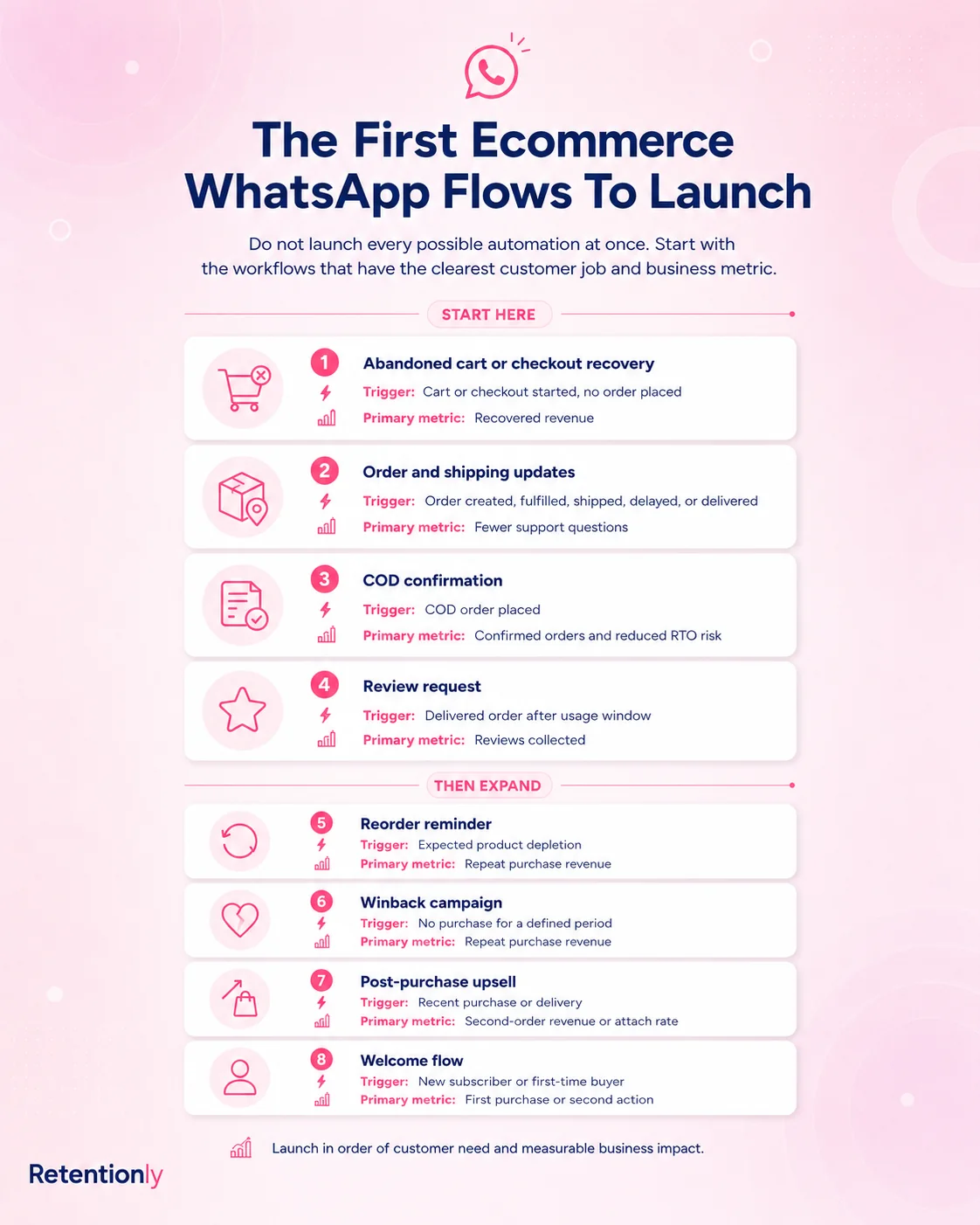
This order is a starting point, not a rule. A COD-heavy brand may start with COD confirmation. A beauty, supplements, food, pet, or home-care brand may prioritize reorder reminders earlier. A fashion brand may need back-in-stock and size-specific campaigns sooner.
The principle is simple: start with the flow where the customer signal is strongest.
Flow 1: Abandoned Cart Recovery
Abandoned cart recovery is often the fastest ecommerce WhatsApp test because the shopper recently showed buying intent.
A clean flow looks like this:
| Component | Practical choice |
|---|---|
| Trigger | Cart or checkout started but no order placed |
| Audience | Opted-in contacts with a valid phone number |
| Timing | First reminder after 30 to 60 minutes |
| Message job | Return the shopper to the saved cart |
| Follow-up | One second reminder after 20 to 24 hours if no purchase |
| Stop rule | Stop after purchase, opt-out, or final reminder |
| Metric | Recovered revenue, conversion rate, opt-outs, replies |
Example message:
Hi [first_name], your [store_name] cart is still saved. You can complete your order here: [checkout_link]. Reply if you have a question before buying.
Start without an automatic discount. If the message underperforms, test timing, product context, reassurance, and then selective offers. Default discounts can train shoppers to wait.
For the Shopify version, use the Shopify Abandoned Cart WhatsApp Recovery Guide.
Flow 2: Order And Delivery Updates
Order updates are not always labeled as marketing, but they support retention. A customer who trusts the post-purchase experience is more likely to buy again.
Useful updates include:
Order confirmation.
Payment confirmation when relevant.
Shipping confirmation.
Tracking link.
Delay notice.
Out-for-delivery update.
Delivery confirmation.
Keep these messages useful and restrained. Do not turn every status change into a WhatsApp notification. Send the updates customers actually want.
Example message:
Your [store_name] order [order_number] has shipped. Track it here: [tracking_link]. We will update you if anything changes.
Avoid hiding promotions inside utility messages. If you want to recommend a related product, use a separate post-purchase upsell flow with the right timing.
Flow 3: COD Confirmation
For ecommerce brands that accept cash on delivery, WhatsApp can protect margin before fulfillment costs are locked in.
The goal is not to market aggressively. The goal is to confirm intent.
| Component | Practical choice |
|---|---|
| Trigger | COD order created |
| Timing | Immediately after order placement |
| Message job | Ask the customer to confirm or cancel |
| Fallback | Tag unconfirmed orders for review |
| Stop rule | Stop after confirm, cancel, prepaid conversion, or manual review |
| Metric | Confirmation rate, cancellation rate, fulfillment savings, RTO reduction |
Example message:
Hi [first_name], please confirm your COD order [order_number] from [store_name]. Reply 1 to confirm or 2 to cancel.
This works because it asks for a simple action at the right moment.
Flow 4: Review Requests
Review requests work when the customer has actually experienced the product. Asking too early produces weak reviews, negative replies, or no response.
Set timing by product type:
| Product type | Better review timing |
|---|---|
| Snacks, accessories, simple items | 1 to 3 days after delivery |
| Apparel and beauty | 3 to 7 days after delivery |
| Supplements or skincare | 10 to 21 days after delivery |
| Home, electronics, durable goods | After setup or usage window |
Example message:
Hi [first_name], hope you are enjoying [product_name]. Could you leave a quick review for [store_name]? It helps other shoppers choose with confidence: [review_link]
Suppress refunded orders, unresolved support issues, failed deliveries, and customers who already reviewed.
Flow 5: Reorder Reminders
Reorder reminders are one of the strongest WhatsApp marketing flows for consumable products.
Good categories include:
Skincare and beauty.
Supplements.
Food and beverage.
Pet products.
Personal care.
Home care.
Any product with a predictable usage cycle.
The trigger should match expected depletion, not a random calendar date.
| Product cycle | Reminder timing |
|---|---|
| 30-day supply | Day 24 to 28 |
| 45-day supply | Day 38 to 42 |
| 60-day supply | Day 50 to 56 |
| Irregular purchase | Use customer history or skip the flow |
Example message:
Running low on [product_name]? You can reorder from [store_name] in one tap here: [reorder_link].
This should feel helpful, not pushy. If the product does not have a replenishment cycle, use winback, cross-sell, or education instead.
Flow 6: Winback Campaigns
Winback campaigns should not rely only on "we miss you" copy. The customer needs a reason to return.
Better segments include:
| Segment | Message angle |
|---|---|
| First-time buyer inactive for 45 days | Bestseller or second-product recommendation |
| Repeat buyer inactive for 60 days | New arrivals in their preferred category |
| VIP inactive for 90 days | Early access, limited drop, or priority support |
| Discount-sensitive buyer | Controlled offer with margin rules |
| Full-price buyer | Product story, bundle, or category recommendation |
Example message:
Hi [first_name], we picked a few new arrivals from [category] based on your last order. You can see them here: [collection_link].
Winback is not always about discounting. Relevance, product fit, and timing often matter more.
Flow 7: Post-Purchase Upsell And Cross-Sell
Upsells work on WhatsApp when the recommendation is obviously connected to the customer's order.
Use purchase data to match:
Refill after starter kit.
Accessory after core product.
Care product after premium item.
Complementary shade, size, flavor, or variant.
Bundle after single-item purchase.
Subscription after repeat purchase behavior.
Example message:
Your [product_name] is on the way. Many customers pair it with [recommended_product] for [specific_benefit]. See it here: [product_link].
Keep the timing respectful. Some products can be recommended immediately after purchase. Others should wait until delivery or first use.
Segmentation Rules For Ecommerce WhatsApp Marketing
Segmentation does not need to be complicated. It needs to be specific enough that the message feels expected.
Start with these segments:
| Segment | Best use |
|---|---|
| Abandoned cart or checkout | Recovery reminders |
| First-time buyers | Welcome, education, reviews, second-order nudges |
| Repeat buyers | Loyalty, VIP, replenishment, early access |
| High-value customers | Premium offers and concierge moments |
| Inactive customers | Winback campaigns |
| Product-category buyers | Cross-sells and relevant launches |
| Delivered orders | Reviews and post-delivery upsells |
| Recent support issue | Suppression from promotional messages |
| Recent purchasers | Suppression from aggressive discounts |
Every segment should answer three questions:
Why is this message relevant to this customer?
Why is now the right time?
What should happen if the customer buys, replies, or opts out?
If the team cannot answer those questions, the campaign is not ready.
Opt-In, Templates, And Frequency
WhatsApp marketing depends on trust. Customers should understand what they are signing up for and how to stop.
Useful opt-in points include:
Checkout consent for order updates and offers.
Post-purchase opt-in for delivery updates, reviews, and reorders.
Popup or embedded form for WhatsApp offers.
Back-in-stock or price-drop signup.
VIP or loyalty signup.
Click-to-WhatsApp ads.
Support conversations where consent is captured clearly.
For business-initiated messages, prepare approved templates around real ecommerce jobs: cart recovery, order updates, COD confirmation, review requests, reorder reminders, winback, and launches.
Frequency should be controlled across the whole customer journey. A customer should not receive a review request, upsell, winback, and sale broadcast in a short window just because each flow was built separately.
Use suppression rules:
Stop cart recovery after purchase.
Suppress promotional campaigns after opt-out.
Exclude refunded or canceled orders from review requests.
Pause winback after any recent purchase.
Suppress campaigns after unresolved support complaints.
Limit promotional sends in a defined period.
Give utility and support messages priority over campaigns.
Good WhatsApp marketing often sends fewer messages than teams expect. It wins because the messages are better timed.
What To Measure
Do not judge WhatsApp only by opens. Measure the business outcome by flow.
| Flow | Primary metric | Secondary checks |
|---|---|---|
| Abandoned cart | Recovered revenue | Conversion rate, clicks, opt-outs, discount use |
| Order updates | Support reduction | Replies, delivery issues, customer satisfaction |
| COD confirmation | Confirmed orders | Cancellations, unconfirmed orders, RTO impact |
| Review request | Reviews collected | Review rate, rating quality, negative replies |
| Reorder reminder | Repeat purchase revenue | Reorder conversion, time between purchases |
| Winback | Repeat purchase revenue | Revenue per recipient, opt-outs, offer cost |
| Upsell | Second-order revenue | Attach rate, AOV lift, replies |
| Broadcast | Campaign revenue | Revenue per recipient, blocks, opt-outs, support load |
Also watch negative signals:
Blocks.
Opt-outs.
Spam reports.
Angry replies.
Rising support load with no owner.
Revenue that depends only on heavier discounts.
If negative signals rise, reduce volume and improve relevance before sending more campaigns.
Common Mistakes
The biggest mistake is starting WhatsApp marketing as a bulk channel instead of a lifecycle channel.
Avoid these mistakes:
Sending every sale to every phone number.
Using the same copy for new buyers, VIPs, inactive customers, and recent purchasers.
Asking for reviews before delivery or product use.
Putting discounts into every abandoned cart message.
Mixing promotional copy into order updates.
Sending winback campaigns without excluding recent purchasers.
Ignoring replies after a campaign goes live.
Measuring opens instead of revenue, repeat purchase, support impact, and opt-outs.
Adding more sends when the real problem is weak segmentation.
WhatsApp is high attention, but that makes relevance more important, not less.
Where Retentionly Fits
Retentionly is built for Shopify and D2C teams that want WhatsApp marketing tied to retention and repeat revenue.
Use Retentionly when your ecommerce team wants to launch flows such as:
Abandoned checkout recovery.
COD confirmation.
Order and shipping updates.
Review requests.
Winback campaigns.
Reorder reminders.
Post-purchase upsells.
Welcome messages and lifecycle campaigns.
The advantage is focus. Instead of buying a broad WhatsApp operations platform and then shaping it into ecommerce workflows, you can start with the revenue moments that already exist in your store.
If you are comparing tools, read the Shopify WhatsApp App Buyer Guide and the Best WhatsApp App for Shopify Guide.
Final Recommendation
Build ecommerce WhatsApp marketing in this order: lifecycle automations first, retention campaigns second, broadcasts third.
Start with the flow that has the clearest customer signal. For many brands, that is abandoned cart recovery. For COD-heavy brands, it may be COD confirmation. For replenishable products, it may be reorder reminders. For brands with high support load, it may be order and delivery updates.
Once the first flow works, add the next retention moment. Keep every message tied to a trigger, segment, timing rule, stop rule, and metric.
That is how WhatsApp becomes a retention channel for ecommerce instead of another place to shout promotions.
Install Retentionly free on Shopify to launch WhatsApp marketing automations for abandoned checkout recovery, COD confirmation, order updates, reviews, winback, reorders, post-purchase upsells, and repeat purchases.