Best WhatsApp Automation Tool for Shopify Retention
TL;DRThe best WhatsApp automation tool is not the tool with the longest feature list. For a Shopify store, it is the tool that can turn store events into useful customer messages: abandoned checkout reminders, COD confirmations, order updates, review requests, winback campaigns, reorder reminders, and post-purchase upsells.
That is why this decision is easy to get wrong. A support team, a sales team, an ecommerce marketer, and a founder may all search for the same phrase but need different products. Some tools are built around inboxes. Some are built around catalogs and conversational commerce. Some are built around chatbots. Some are built around Shopify retention workflows.
This guide compares the best WhatsApp automation tool options by buying fit, pricing model, workflow depth, and setup effort so Shopify merchants can choose the right category before committing to a platform.
Quick Verdict
If your store wants WhatsApp to recover revenue and bring customers back, choose a Shopify retention automation tool first. If WhatsApp is going to be a company-wide support, sales, and operations layer, a broader WhatsApp platform may be the better fit.
| Best fit | Tool type to compare first | Why |
|---|---|---|
| Shopify retention, abandoned checkout, COD, reviews, winback, reorders, and upsells | Retentionly or another Shopify-first retention automation tool | The first workflows start from Shopify events and revenue outcomes |
| Catalog selling, campaigns, inbox, AI bots, and WhatsApp commerce | Zoko or a broad WhatsApp commerce platform | Stronger fit when WhatsApp is a sales and commerce channel |
| Company-wide WhatsApp operations, campaigns, bots, and team inbox | Wati or a broad WhatsApp Business platform | Better for teams that need a larger WhatsApp operating system |
| WhatsApp plus Instagram marketing, support, and sales | Interakt or a social commerce platform | Useful when Instagram and WhatsApp are managed together |
| Shopify automation plus AI support and inbox features | Dondy or a Shopify automation platform with AI support | Relevant when the team wants automation plus assistant-style workflows |
| Omnichannel ecommerce support with WhatsApp marketing | DelightChat or a helpdesk-led platform | Best when support tickets and team workflows are central |
| Custom internal workflows across many systems | API provider, Zapier, Make, n8n, or developer-owned setup | Flexible, but requires more maintenance |
For most Shopify stores, the buying question should be narrower than "Which WhatsApp tool has the most features?" Ask: "Which tool can run the first three flows that will actually improve revenue or reduce support load?"
What "Best" Means For A Shopify Store
For Shopify merchants, WhatsApp automation should usually start with customer lifecycle events. Those events already show intent, risk, or timing.
| Shopify moment | Useful WhatsApp automation | Business outcome |
|---|---|---|
| Checkout started but no order placed | Abandoned checkout reminder with cart link | Recovered revenue |
| COD order placed | Confirm or cancel reply flow | Lower fake-order and RTO risk |
| Order created, fulfilled, shipped, or delivered | Order and shipping updates | Fewer repetitive support questions |
| Delivery completed | Review request with support fallback | More reviews and better issue routing |
| Customer inactive | Winback message with relevant offer | Repeat purchases |
| Consumable product likely due for refill | Reorder reminder | Higher repeat purchase rate |
| Recent order has a natural companion product | Post-purchase upsell | Higher customer value |
A tool that handles these workflows well may be a better choice than a broader platform with more channels, more bot options, or more dashboards.
The best tool should help you answer five practical questions:
What Shopify event starts the automation?
Which customers should receive it?
What message should they receive, and when?
What should stop the flow?
Which metric proves the flow worked?
If a platform makes those answers obvious, it is closer to the right fit.
Comparison Criteria That Actually Matter
Use this scorecard before choosing a WhatsApp automation tool.
| Criterion | What a strong tool shows | Warning sign |
|---|---|---|
| Shopify trigger depth | Checkout, order, fulfillment, delivery, customer, tag, and purchase-history triggers | Generic contact lists or manual uploads drive most automations |
| Lifecycle workflow ownership | Flows are organized around ecommerce outcomes | The product starts from chatbot menus or campaign blasts |
| Stop rules | Purchases, opt-outs, negative replies, ineligible order states, and suppression rules stop messages | Messages keep sending unless manually paused |
| Template handling | Approved WhatsApp templates, variables, fallback copy, and category awareness | Templates are treated like simple copy blocks |
| Reply handling | Clear owner for replies, inbox handoff, and escalation path | No plan for customer replies after automation starts |
| Reporting | Recovered orders, attributed revenue, confirmation rate, replies, opt-outs, failed sends, and flow-level results | Only sent, delivered, or read counts |
| Pricing model | Subscription, Meta fees, markup, add-ons, users, limits, and automation charges are easy to model | Low entry price but unclear cost once flows work |
| Setup effort | First useful Shopify flow can go live quickly | A broad platform must be configured before revenue workflows start |
This is where many "best tools" lists fail. They compare feature breadth when the better comparison is workflow fit.
Best WhatsApp Automation Tools By Use Case
There is no universal winner. The strongest choice depends on the job WhatsApp needs to do for your store.
| Tool or category | Best for | Main tradeoff to check |
|---|---|---|
| Retentionly | Shopify retention automation and lifecycle revenue flows | Not meant to replace every broad support or sales operation |
| Zoko | WhatsApp commerce, catalog selling, campaigns, inbox, and automation for D2C brands | Pricing and setup include more layers if you only need retention flows |
| Wati | Broad WhatsApp Business operations, campaigns, inboxes, bots, and team workflows | Shopify retention may be one use case inside a larger system |
| Interakt | WhatsApp and Instagram marketing, support, sales, and cart recovery | The platform decision can become channel-led rather than workflow-led |
| Dondy | Shopify WhatsApp automation with AI, support, campaigns, and Shopify Flow use cases | Check which automations and message rates belong to which tier |
| DelightChat | Ecommerce helpdesk plus WhatsApp marketing and support automation | Strongest when support ownership matters as much as automation |
| API or no-code stack | Custom workflows across multiple systems | Requires implementation, testing, monitoring, and template operations |
If the first goal is a measurable Shopify retention flow, Retentionly should be on the shortlist. If the first goal is a shared inbox, catalog selling, or cross-channel support operations, the broader tools may be the better first comparison.
Retentionly: Best For Shopify Retention Automation
Retentionly is built for Shopify and D2C teams that want WhatsApp to improve retention, repeat purchase, and lifecycle revenue.
The strongest fit is a store that wants to launch abandoned checkout recovery, COD confirmation, order updates, review requests, winback campaigns, reorder reminders, post-purchase upsells, welcome flows, and segmented broadcasts without building a large WhatsApp operations stack first.
Retentionly is a good fit when:
Shopify events should trigger the automation.
A founder, marketer, or ecommerce operator owns WhatsApp.
The first metric is recovered revenue, repeat orders, confirmations, reviews, or support reduction.
The team wants clear pricing as message volume grows.
The store wants WhatsApp automation, not a generic bulk sender.
Retentionly pricing is simple: Basic at $24/month, Growth at $49/month, and Scale at $99/month. Retentionly connects directly to Meta, does not add a markup on Meta message fees, does not charge extra for adding automations, and does not charge per chat.
The tradeoff is focus. Retentionly is not trying to be the broadest WhatsApp platform for every department. That is useful if your main goal is Shopify retention. It may be less useful if you need a full helpdesk, large agent operation, or advanced catalog-selling system as the primary product.
For the broader category context, read the Shopify WhatsApp Automation Guide.
Zoko: Best For WhatsApp Commerce And Catalog-Led Selling
Zoko is a strong option for D2C brands that want WhatsApp to be a commerce, support, automation, inbox, and catalog channel. Its Shopify App Store listing emphasizes Shopify catalog sync, segmented campaigns, abandoned cart recovery, order notifications, multi-agent inbox workflows, AI bots, and automated retention flows.
Zoko makes sense when WhatsApp is a large part of how the store sells, supports, and markets to customers. If catalog buying inside WhatsApp, team handovers, AI bots, Shopify segments, and a shared inbox all matter, it belongs on the shortlist.
The tradeoff is that the buyer should model the full operating cost. Zoko's public Shopify App Store pricing currently starts at $49.99/month and includes Meta rates plus possible conversation fees, agent limits, Instagram add-ons, custom-flow add-ons, and AI bot add-ons depending on plan and usage.
That does not make Zoko the wrong choice. It means a Shopify retention buyer should compare whether the extra commerce and inbox breadth is needed before the first few lifecycle flows are live.
Wati: Best For Broad WhatsApp Business Operations
Wati is a broad WhatsApp Business platform for campaigns, team inboxes, chatbots, sales, support, and operations. It can make sense when WhatsApp is a company-wide channel rather than one Shopify retention workflow.
Choose Wati when multiple teams need one WhatsApp operating system, when agent workflows matter, or when advanced WhatsApp Business API operations are more important than a narrow retention setup.
The pricing model needs careful review. Wati describes pricing as a combination of subscription plan, messaging charges, and optional add-ons. Its plans include Growth, Pro, and Business, and Wati's help content notes the shift to Meta's message-based pricing model after July 1, 2025.
For Shopify merchants, the buying check is not whether Wati can support WhatsApp automation. It can. The buying check is whether your store needs that broader operating layer or whether a focused Shopify retention tool gets the first result faster.
Interakt: Best For WhatsApp And Instagram Sales Workflows
Interakt is positioned around WhatsApp and Instagram automation for marketing, support, and sales. Its Shopify App Store listing includes abandoned cart reminders, bulk campaigns, COD confirmation, order updates, shared inbox, chat widgets, auto-replies, Instagram automation, and chatbot features.
Interakt can be a good fit when a merchant wants WhatsApp and Instagram handled together. It is also relevant for stores that want a lower entry subscription with support, marketing, and sales workflows in one platform.
Interakt's public Shopify App Store pricing currently shows Starter, Growth, and Advanced plans around $21, $41, and $51/month, with additional WhatsApp conversation charges. As with any WhatsApp platform, the monthly plan does not tell the full story. The real comparison is which plan supports the automations, volume, and team workflow your store needs.
If your priority is Shopify retention, compare Interakt against Retentionly on trigger depth, stop rules, revenue reporting, and setup effort. If Instagram and social commerce are central, Interakt may be stronger.
Dondy: Best For Shopify Automation Plus AI Support
Dondy is close to the Shopify WhatsApp automation lane. Its Shopify App Store positioning covers abandoned cart recovery, WhatsApp marketing, COD, campaigns, AI agents, support, reviews, order updates, shipping alerts, Shopify segments, and Shopify Flow use cases.
Dondy is worth comparing when the store wants Shopify WhatsApp automation plus AI support or inbox capabilities. It is more Shopify-specific than many broad WhatsApp platforms, which makes it especially relevant for merchants comparing automation tools.
The pricing check is important. Dondy's public pricing includes a free widget plan, a low-cost Pro plan, Power Automation at $79.99/month, and Elite at $159.99/month. The higher tiers unlock the more serious automation, WhatsApp API, inbox, and AI capabilities, with WhatsApp rates and included-message details to verify before choosing.
If your team wants AI support and WhatsApp automation together, Dondy may fit. If the main goal is a lean retention workflow system with simple economics, compare it against Retentionly workflow by workflow.
DelightChat: Best When WhatsApp Belongs To Support
DelightChat is an ecommerce support and helpdesk platform with WhatsApp marketing and API features. Its Shopify App Store listing includes WhatsApp broadcasts, abandoned cart and checkout recovery, COD flows, Shopify Flow workflows, GPT assistant features, support inbox, email, Instagram, Facebook, chat, and support ticket limits.
This is useful when the support team owns WhatsApp. If the store needs WhatsApp inside a broader helpdesk, with multiple channels and ticket workflows, DelightChat can be the better fit than a retention-only automation tool.
DelightChat's public Shopify App Store pricing currently starts at $29/month and scales through higher plans with support-ticket, marketing-contact, team-member, channel, store, onboarding, and support limits.
The tradeoff is ownership. If WhatsApp is primarily a support desk, DelightChat belongs in the comparison. If WhatsApp is primarily a lifecycle revenue channel, the merchant should compare how quickly each tool launches and measures retention flows.
Pricing Comparison: Model The Real Cost
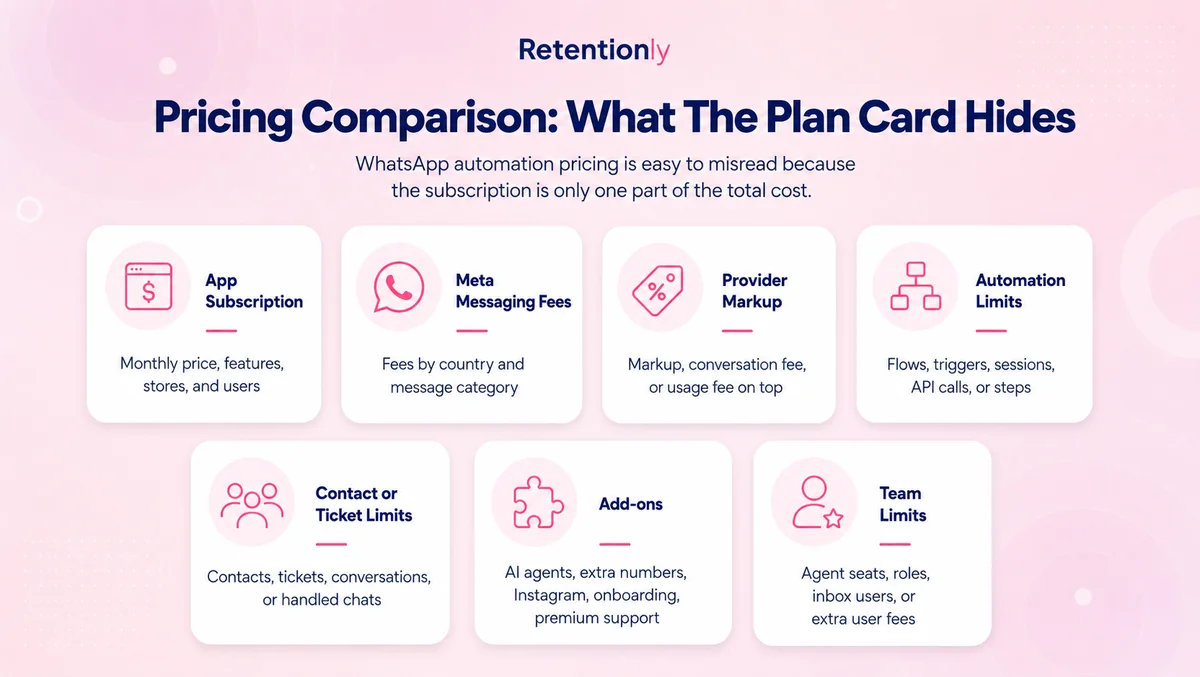
WhatsApp automation pricing has more than one layer. Do not compare only the first monthly plan shown on a pricing card.
| Cost layer | What to verify |
|---|---|
| Subscription | Monthly price, annual discount, included features, stores, users, and support level |
| Meta messaging fees | WhatsApp Business Platform fees by message category, country, and volume |
| Provider markup or usage fee | Whether the platform adds a markup, conversation fee, handled-chat fee, or usage charge |
| Automation limits | Flow count, trigger volume, API calls, chatbot sessions, custom flows, or advanced workflow access |
| Contact, ticket, or agent limits | Contacts, tickets, agents, stores, support channels, or marketing contacts |
| Add-ons | AI bots, Instagram, custom flows, extra numbers, onboarding, premium support, or back-in-stock alerts |
| Operational cost | Who configures flows, monitors replies, updates templates, and improves reporting |
Here is the practical pricing-model comparison for Shopify merchants:
| Tool | Public pricing pattern to check | Best-fit pricing question |
|---|---|---|
| Retentionly | $24, $49, and $99/month; no Retentionly markup on Meta fees; no extra automation or per-chat fee | Do you want clearer retention economics as flows grow? |
| Zoko | Starts at $49.99/month with Meta rates, conversation fees or allowances, agent limits, custom flows, Instagram, and AI bot add-ons | Do you need commerce, catalog, inbox, and AI breadth enough to justify the layers? |
| Wati | Growth, Pro, and Business plans with messaging charges and optional add-ons | Do you need a broad WhatsApp operations platform? |
| Interakt | App Store plans around $21, $41, and $51/month plus additional WhatsApp conversation charges | Do you need WhatsApp and Instagram sales/support workflows together? |
| Dondy | Free and low-cost entry plans, with Power Automation at $79.99/month and Elite at $159.99/month | Which automation, API, inbox, and AI tier matches your first workflows? |
| DelightChat | Starts at $29/month and scales by tickets, contacts, team, channels, stores, and support level | Is WhatsApp part of a wider ecommerce helpdesk? |
Pricing changes often. Before buying, verify the live pricing page and calculate the cost of your first three months of expected usage, not only the cheapest advertised plan.
Workflow Comparison For Shopify Stores
If the goal is retention, compare tools by the flows they can own from Shopify data.
| Workflow | What the tool must handle | Why it matters |
|---|---|---|
| Abandoned checkout | Checkout trigger, cart link, timing, follow-up, stop on purchase, revenue attribution | Usually the fastest revenue test |
| COD confirmation | COD order trigger, confirm/cancel replies, tags, fulfillment hold, non-response fallback | Reduces avoidable fulfillment waste |
| Order updates | Order, fulfillment, shipping, delivery, delay, and tracking events | Reduces "where is my order" tickets |
| Review requests | Delivery-based timing, review-app handoff, unhappy-reply support routing | Turns fulfilled orders into social proof |
| Winback | Last purchase date, customer segment, offer, timing, suppression rules | Re-engages dormant customers |
| Reorder reminders | Product cycle, purchase history, expected replenishment timing | Drives repeat purchase for consumables |
| Post-purchase upsell | Product purchased, complementary product, timing, stop on purchase | Grows customer value without blasting every subscriber |
| Broadcasts | Consent, segments, campaign calendar, opt-outs, reply owner | Useful after lifecycle automations are disciplined |
For tactical examples, read the Shopify Abandoned Cart WhatsApp Recovery Guide, Shopify COD Confirmation WhatsApp Guide, and Shopify Order Updates WhatsApp Automation Guide.
When A Broad Tool Is The Better Choice
Broad WhatsApp platforms are not wrong. They are often the right choice when the business need is broader than Shopify retention.
Choose a broad platform when:
WhatsApp is owned by sales, support, and marketing together.
Agents spend most of the day replying to WhatsApp conversations.
Catalog selling inside WhatsApp is a major revenue motion.
You need advanced chatbots, AI routing, or manual sales workflows.
Instagram, Facebook, email, live chat, or helpdesk workflows matter as much as Shopify events.
You have someone responsible for maintaining a larger platform.
In those cases, a tool such as Zoko, Wati, Interakt, Dondy, or DelightChat may make sense depending on the team and region.
The mistake is choosing a broad platform before you know whether your first outcome requires it.
When A Shopify Retention Tool Is The Better Choice
A Shopify retention tool is the better choice when the owner is a founder, ecommerce operator, lifecycle marketer, or retention manager.
Choose this path when:
The first goal is recovered revenue or repeat purchase.
The automation should start from Shopify behavior.
You want fewer setup steps before the first flow is live.
You care about flow-level reporting.
You want pricing to stay understandable as WhatsApp volume grows.
You do not need a large support desk or sales operations system on day one.
This is where Retentionly fits. It helps Shopify stores use WhatsApp for lifecycle automation rather than turning WhatsApp into a broad platform project before the first revenue flow has proved itself.
Final Recommendation
The best WhatsApp automation tool is the one that matches the job your store actually needs done.
If WhatsApp is a support and sales operations channel, compare broad platforms. If WhatsApp is part of an omnichannel helpdesk, compare support-led tools. If your team needs custom internal workflows, compare API and no-code options carefully.
But if you are a Shopify merchant trying to recover abandoned checkouts, confirm COD orders, send better order updates, collect reviews, win back customers, trigger reorders, and drive post-purchase revenue, start with Shopify retention automation.
Install Retentionly free on Shopify if you want WhatsApp automation built around Shopify events, lifecycle revenue, repeat purchases, and clear message economics instead of a platform your team may not need yet.
Quick FAQs
What is the best WhatsApp automation tool for Shopify?
The best tool depends on the job. Retentionly is a strong fit for Shopify retention automation. Broader tools such as Zoko, Wati, Interakt, Dondy, and DelightChat may fit better when WhatsApp is also a support desk, sales inbox, catalog channel, or omnichannel operations layer.
What should a Shopify store automate first on WhatsApp?
Most stores should start with abandoned checkout recovery because it targets existing purchase intent. COD-heavy stores may start with COD confirmation. Stores with high support volume may start with order and shipping updates.
Is WhatsApp automation the same as a chatbot?
No. A chatbot is one type of automation. Shopify WhatsApp automation can also include abandoned checkout reminders, COD confirmation, order updates, review requests, winback flows, reorder reminders, post-purchase upsells, broadcasts, and support handoffs.
Do WhatsApp automation tools charge Meta messaging fees?
Most official WhatsApp Business Platform tools involve Meta messaging fees. Check whether the provider passes Meta fees directly, adds markup, charges conversation or usage fees, or bundles costs into plan limits.
Should I choose Retentionly or a broader WhatsApp platform?
Choose Retentionly when your main goal is Shopify retention automation and lifecycle revenue. Choose a broader platform when WhatsApp is also your support desk, sales inbox, catalog channel, chatbot system, or multi-team operations layer.