Wati Pricing for Shopify: What Store Owners Should Compare
TL;DRWati pricing is not just the monthly plan on the pricing page. For a Shopify store, the real cost depends on the subscription, WhatsApp message fees, Shopify add-ons, automation usage, users, inbox needs, and how many retention workflows you want to run.
That matters because Shopify teams usually do not buy WhatsApp software for one isolated feature. They want abandoned checkout recovery, COD confirmation, order updates, winback messages, review requests, broadcasts, and support conversations to work together without creating a confusing bill.
This guide breaks down how to think about Wati pricing as a Shopify merchant, what to check before choosing a plan, and when a Shopify-first alternative like Retentionly may be a cleaner fit.
Quick Verdict
Wati can make sense if your team wants a broad WhatsApp operations platform for campaigns, sales, support, chatbots, inbox management, ads, and ecommerce workflows.
Retentionly is the stronger fit if your main goal is Shopify WhatsApp retention automation: recovering checkouts, confirming COD orders, sending lifecycle updates, winning back customers, and driving repeat purchases with simpler pricing.
| Buying question | Wati | Retentionly |
|---|---|---|
| Main job | Broad WhatsApp business platform | Shopify and D2C retention automation |
| Pricing model to review | Plan, message fees, add-ons, users, automation triggers, Shopify add-on | Fixed plan, direct Meta connection, no Retentionly markup on Meta fees |
| Best-fit team | Support, sales, campaigns, chatbot, and operations teams | Shopify founders, marketers, ecommerce managers, and retention teams |
| Main tradeoff | More platform breadth, more cost variables | Narrower scope, clearer retention workflow economics |
How Wati Pricing Works
Wati describes its pricing around three main cost components: subscription fee, messaging fee, and optional add-ons. That is the right lens for Shopify merchants too.
The subscription fee is the recurring platform plan. Wati's current plan structure includes Growth, Pro, and Business, with some page variations by country, billing cycle, and plan selection. Wati also shows message charges separately, based on WhatsApp's message-based pricing model and the country where messages are sent.
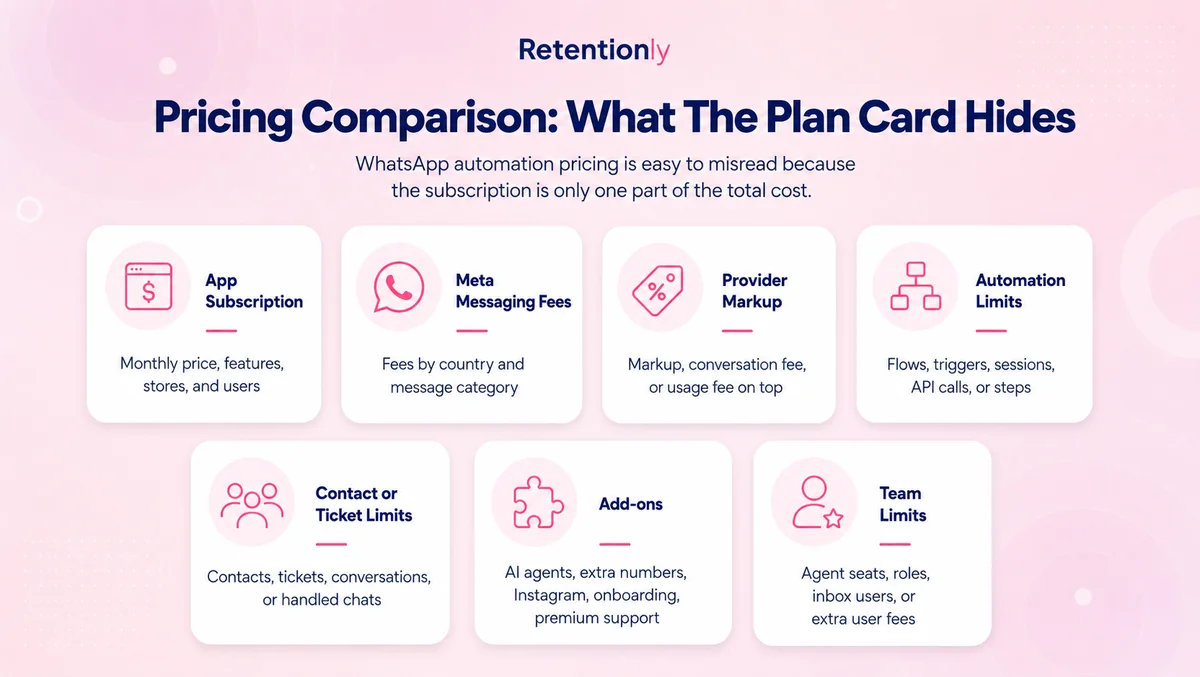
The practical point is simple: a Shopify store should not compare Wati only by the first visible monthly plan. The cost of a real WhatsApp retention setup can include several layers.
| Cost layer | What to check |
|---|---|
| Subscription | Which Wati plan is required for your Shopify workflow and team size? |
| WhatsApp message fees | Which message categories and destination countries will you send to? |
| Shopify access | Does the Shopify workflow you need require an add-on or higher plan? |
| Automation usage | How many automation triggers are included before you need more capacity? |
| Users and teams | How many agents, owners, or teams can use the plan? |
| AI and chatbot usage | Are AI replies, chatbot capacity, or advanced automation limits relevant? |
| Support level | Does the plan include the support level your team will need during setup? |
If you are running one small campaign, this may not feel complicated. If WhatsApp becomes a daily retention channel, these variables matter.
The Wati Pricing Details Shopify Merchants Should Notice
For Shopify teams, the most important Wati pricing question is not "What is the cheapest plan?" It is "Which plan unlocks the workflows and capacity we actually need?"
Wati's current public materials show several cost and usage points that Shopify buyers should evaluate:
| Pricing detail | Why it matters for Shopify |
|---|---|
| Growth, Pro, and Business plans | The plan determines included users, integrations, automation limits, support, and advanced features. |
| Additional message charges | WhatsApp costs can scale with campaigns, abandoned checkout recovery, order updates, and retention flows. |
| Automation trigger limits | Shopify flows can trigger often once cart recovery, order updates, and campaign actions are active. |
| User and team limits | Support-heavy teams may need more inbox seats or team controls. |
| Shopify add-on note | If Shopify functionality needs a paid add-on, include it in total cost. |
| AI and chatbot limits | These matter if you want Wati as a support and chatbot platform, not only a retention tool. |
| Annual billing discounts | The monthly equivalent may depend on billing commitment. |
This does not mean Wati pricing is bad. It means Wati is a broader platform, so its pricing has broader platform variables.
A Shopify retention team should model the cost around the flows it plans to launch in the first 90 days:
Abandoned checkout recovery.
COD confirmation.
Order and shipping updates.
Review requests.
Winback messages.
Post-purchase upsells or repeat purchase reminders.
Broadcasts to opted-in segments.
If a plan or add-on changes the economics of those flows, it belongs in the pricing comparison.
Wati Pricing Vs Retentionly Pricing
Retentionly pricing is intentionally simpler for Shopify and D2C teams.
| Retentionly plan | Price | Best for |
|---|---|---|
| Basic | $24/month | Core WhatsApp automations and basic features |
| Growth | $49/month | Broadcasts and advanced automations such as winback |
| Scale | $99/month | CRM features and multi-agent chat |
Retentionly connects directly to Meta and does not add a markup on Meta messaging fees. It also does not charge extra for added automations and does not charge per-chat fees.
For a Shopify merchant, that changes the buying question. Instead of asking how to assemble a broad WhatsApp platform, you can ask which retention workflows should go live first and how much revenue they need to recover.
| Pricing area | Wati | Retentionly |
|---|---|---|
| Platform plan | Broad WhatsApp plans with multiple feature and usage variables | Three Shopify-focused plans |
| Meta/WhatsApp fees | Message fees apply based on WhatsApp pricing and destination | Direct Meta connection, no Retentionly markup |
| Automation cost | Check included automation triggers and any capacity needs | No extra cost for added automations |
| Shopify fit | Supports Shopify use cases inside a broader WhatsApp platform | Built around Shopify retention workflows |
| Inbox and agents | Stronger fit for broad team inbox operations | Scale plan includes CRM features and multi-agent chat |
| Best cost comparison | Total WhatsApp operations cost | Retention workflow cost and revenue recovery |
If your team wants WhatsApp to become a full support, sales, campaigns, AI, and operations layer, Wati may be worth the extra evaluation. If your team wants a WhatsApp retention system for Shopify, Retentionly is usually the cleaner comparison.
When Wati Is Worth Paying For
Wati can be the right choice when WhatsApp is not only a retention channel. It is a broad operating system for customer conversations.
That can include a shared team inbox, sales conversations, chatbot flows, AI support, click-to-WhatsApp ads, campaign management, multiple team members, and ecommerce messaging from one platform. Wati also publishes Shopify-specific materials around abandoned cart recovery, order confirmations, shipping updates, product recommendations, and support.
For larger teams, that breadth can be valuable. A support lead may want inbox routing. A sales team may want manual conversations. A marketing team may want campaigns and ads. An operations team may want broader automation.
In that case, the right way to evaluate Wati pricing is to map each team requirement to the plan, add-on, usage limit, and support level it needs.
When Wati Pricing Can Feel Heavy For Shopify Retention
Wati pricing can feel heavier when the Shopify team mostly wants lifecycle revenue flows.
If your main workflows are abandoned checkout, COD confirmation, order updates, winback, reviews, and repeat purchase reminders, a broad WhatsApp platform can create buying noise. You may end up comparing chatbot limits, team seats, AI credits, automation triggers, campaign features, inbox workflows, and add-ons before the core retention flows are live.
That is where a Shopify-first product can be more practical.
Retentionly starts from the Shopify event and the revenue job:
| Shopify moment | Retentionly angle |
|---|---|
| Checkout abandoned | Recover the cart before intent fades |
| COD order placed | Confirm the order and reduce avoidable RTO |
| Order shipped | Keep the buyer updated and reduce support tickets |
| Product delivered | Ask for a review at the right moment |
| Customer inactive | Trigger a winback flow based on last purchase timing |
| Repeat purchase window | Send a reorder or upsell message when it is commercially relevant |
The goal is not to buy the largest WhatsApp feature set. The goal is to launch the messages that protect and grow Shopify revenue.
A Shopify Pricing Checklist Before Choosing Wati
Before choosing Wati for Shopify, answer these questions with your real store workflows in mind.
| Question | Why it matters |
|---|---|
| Which Shopify automations will be live in month one? | Prevents paying for broad capacity before revenue flows are mapped. |
| Which plan includes the Shopify features you need? | Avoids discovering plan limits after setup starts. |
| Are message fees clear for your buyer countries? | WhatsApp costs vary by country and message category. |
| Do you need chatbots or only automations? | Chatbot and AI requirements can change the plan decision. |
| How many agents need the inbox? | Seat, team, and routing needs matter for support-heavy stores. |
| Will broadcasts be frequent? | Campaign volume changes the message-fee forecast. |
| Do you need COD analytics, abandoned cart analytics, or revenue reporting? | Shopify operators should connect spend to recovered revenue. |
| Can the first retention flows pay for the plan? | The best pricing comparison is tied to revenue impact, not feature count. |
If the answers point to broad WhatsApp operations, Wati belongs on the shortlist. If the answers keep returning to Shopify retention, Retentionly is the more focused option.
Example: How To Compare The Cost Of One Retention Flow
Take abandoned checkout recovery.
A Shopify store should compare:
| Cost or value item | What to estimate |
|---|---|
| Monthly platform plan | The minimum plan needed for the workflow |
| Shopify add-on or plan requirement | Whether the workflow needs extra Shopify access |
| Message fees | Number of reminders sent by country and message type |
| Automation usage | How many checkout events trigger the flow |
| Support workload | Whether replies need agents or simple routing |
| Revenue recovered | Carts recovered and order value recovered |
Now compare that with the simpler Retentionly question: how much abandoned checkout revenue can a Shopify WhatsApp automation recover, and which plan gives you the lifecycle flows you need next?
The same logic applies to COD confirmation, winback, review requests, and repeat purchase reminders. Price only makes sense when it is tied to the workflow it supports.
Final Recommendation
If you need Wati because WhatsApp is becoming a broad support, sales, AI, campaign, and operations platform, evaluate Wati carefully and include every cost layer in your forecast.
If you are mainly comparing Wati pricing because you want WhatsApp to grow Shopify retention revenue, start with a narrower question: which tool gets the right Shopify-triggered flows live with the least pricing complexity?
Retentionly is built for that job. It gives Shopify and D2C teams simple plans, direct Meta connection without Retentionly markup on Meta fees, no extra cost for added automations, and workflows focused on the customer moments that drive repeat revenue.
Install Free on Shopify and start with the flows that can pay for themselves first: abandoned checkout, COD confirmation, order updates, winback, reviews, and repeat purchase.
Quick FAQs
What is Wati pricing for Shopify?
Wati pricing for Shopify depends on the selected plan, WhatsApp message fees, Shopify-related access, automation usage, users, add-ons, and billing cycle. Shopify merchants should compare total operating cost rather than only the first monthly plan.
Does Wati charge separately for WhatsApp messages?
Wati's help center describes messaging fees as a separate pricing component based on WhatsApp's message-based pricing model and the destination country. Merchants should check the current rate card for their countries and message categories.
Is Wati good for Shopify abandoned cart recovery?
Wati supports Shopify abandoned cart and checkout recovery workflows. It can be a good fit when you also want broader WhatsApp inbox, campaign, chatbot, and support capabilities.
When is Retentionly a better fit than Wati?
Retentionly is a better fit when your main goal is Shopify retention automation rather than a broad WhatsApp operations platform. It is designed around abandoned checkout, COD confirmation, order updates, winback, reviews, upsells, and repeat purchase workflows.
What should I compare before choosing Wati?
Compare the subscription, message fees, Shopify add-ons, automation trigger limits, users, team needs, chatbot or AI requirements, support level, and whether the first few Shopify retention flows can recover enough revenue to justify the setup.