Twilio WhatsApp Alternative: App-Based Options to Compare
TL;DRIf you are comparing Twilio WhatsApp alternatives, the real decision is not whether Twilio can send WhatsApp messages. It can. The decision is whether your Shopify team wants to build on programmable communications infrastructure or install an app that already understands ecommerce retention workflows.
Twilio is a strong fit for teams with developers, custom product requirements, and a broader communications roadmap across messaging, voice, verification, support, or customer data. But many Shopify founders, marketers, and ecommerce managers are not trying to become communications platform operators. They want abandoned checkout recovery, COD confirmation, order updates, review requests, winback campaigns, post-purchase upsells, and reorder reminders to go live with less technical assembly.
That is where Retentionly is the sharper Twilio WhatsApp alternative for Shopify stores.
Quick Verdict
Choose Twilio if your team wants programmable WhatsApp infrastructure and has the technical resources to build, test, maintain, and connect the workflows around it.
Choose Retentionly if your main goal is Shopify WhatsApp retention automation: store-triggered flows that recover revenue, reduce operational friction, and bring customers back for another purchase.
| Best fit | Twilio WhatsApp | Retentionly |
|---|---|---|
| Primary job | Programmable WhatsApp messaging and communications infrastructure | Shopify/D2C retention automation |
| Strongest buyer | Developers, product teams, platform teams, and companies with custom communication requirements | Shopify founders, marketers, and ecommerce managers focused on lifecycle revenue |
| Core question | "How do we build the communication system we need?" | "How do we launch the Shopify WhatsApp flows that drive revenue?" |
| Main advantage | Flexibility, API control, and cross-channel extensibility | Workflow focus, faster setup, and clearer ownership for Shopify retention |
Pricing Comparison: Compare The Full Operating Model
Twilio WhatsApp pricing should be evaluated as a usage-based communications model. The final cost can depend on country, message direction, message type, Meta WhatsApp charges, Twilio charges, customer support needs, developer time, and any extra products used to build the complete workflow.
That model can be powerful when your team is building a custom messaging layer. It can also be harder to forecast when your real need is narrower: run a handful of Shopify revenue workflows without paying for unnecessary complexity.
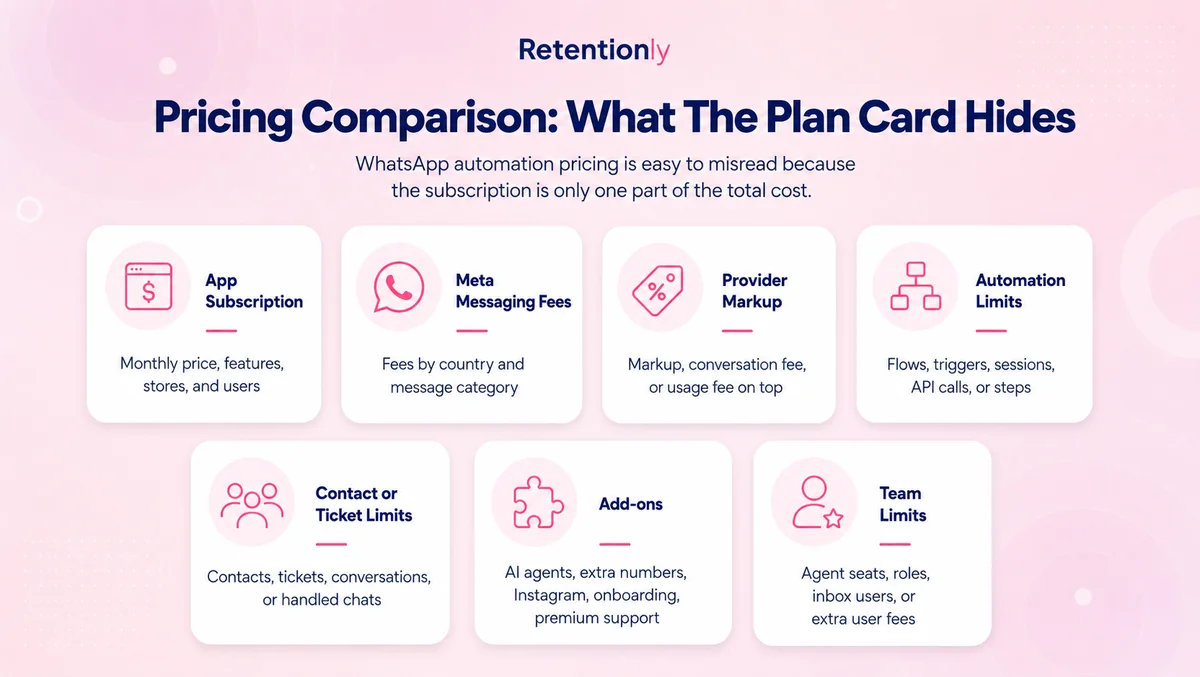
Retentionly pricing is intentionally simpler:
| Retentionly plan | Price | Best for |
|---|---|---|
| Basic | $24/month | Basic automations and core features |
| Growth | $49/month | Broadcasts and advanced automations, including winback workflows |
| Scale | $99/month | CRM features and multi-agent chat |
Retentionly connects directly to Meta and does not add a markup on Meta messaging fees. It also does not charge extra for added automations and does not charge per-chat fees.
| Pricing question | Twilio WhatsApp | Retentionly |
|---|---|---|
| Base software model | Usage-based communications platform; verify current WhatsApp rates and required supporting products | Clear monthly app plans starting at $24/month |
| Meta message fees | Buyer should separate Meta WhatsApp fees from Twilio and implementation costs | Meta rates apply with no Retentionly markup |
| Developer cost | Often part of the real cost because workflows need to be built and maintained | App-led setup for Shopify retention workflows |
| Automation cost | Depends on how the team builds flows, integrations, logic, dashboards, and handoff | No extra charge for added automations |
| Forecasting difficulty | Higher when volume, geographies, categories, and custom infrastructure vary | Easier for Shopify teams planning retention workflows |
| Best pricing fit | Teams that want API control and can model total build plus usage cost | Teams that want predictable WhatsApp retention automation economics |
The pricing takeaway is not "Twilio is expensive" or "Retentionly is always cheaper." The right question is which operating model matches the job. If you need programmable communications infrastructure, Twilio can be worth the build. If you need Shopify WhatsApp workflows live quickly, an app-based model is easier to evaluate.
Feature Comparison
Twilio and Retentionly solve different layers of the WhatsApp problem. Twilio gives technical teams flexible messaging infrastructure. Retentionly gives Shopify teams packaged retention workflows.
| Feature or buying criterion | Twilio WhatsApp | Retentionly |
|---|---|---|
| WhatsApp Business Platform access | Strong API-led access through Twilio | Included as part of Shopify automation setup |
| Shopify integration depth | Possible through custom integration or supporting tools | Built around Shopify store events and customer lifecycle workflows |
| Abandoned checkout recovery | Buildable with checkout data, templates, timing logic, and recovery tracking | Core revenue workflow |
| COD confirmation | Buildable with order data, reply handling, and fulfillment rules | Core Shopify/D2C workflow |
| Order updates | Strong notification use case if order and shipping events are connected | Core lifecycle automation |
| Review requests | Buildable with delivery timing, review links, and template logic | Designed as a post-purchase retention flow |
| Winback campaigns | Buildable with customer segmentation and campaign logic | Growth plan includes advanced automations such as winback |
| Post-purchase upsell | Buildable with product data, offer logic, and stop rules | Built as a repeat revenue workflow |
| Reorder reminders | Buildable with purchase-cycle logic | Designed around repeat purchase timing |
| Shared inbox and handoff | Possible through Twilio ecosystem choices or custom setup | Available where needed, but not the center of the product |
| Cross-channel communications | Stronger fit when WhatsApp is one channel in a broader communications platform | Focused on WhatsApp for Shopify retention |
| Setup complexity | Flexible but more technical | Designed for quicker Shopify workflow launch |
| Best-fit team | Teams with developers and custom communication architecture needs | Shopify teams that want retention flows without building an API layer |
The deciding question is not which product has the longer feature surface. It is which product owns the workflow your store needs next.
Shopify Workflow Comparison
A Shopify WhatsApp system should not stop at sending messages. It should know what triggered the message, when to send it, when to stop, what reply matters, and which Shopify metric proves it worked.
| Workflow | What the workflow needs | Twilio fit | Retentionly fit |
|---|---|---|---|
| Abandoned checkout | Checkout trigger, delay, recovery link, suppression after purchase, recovered revenue | Good if the team builds the event, template, and tracking path | Core flow built around revenue recovery |
| COD confirmation | Order trigger, confirm/cancel reply handling, fulfillment stop rules, RTO reduction metric | Buildable with custom logic and operations rules | Core Shopify/D2C workflow |
| Order updates | Order, shipping, delivery, and exception events | Strong API notification use case if data wiring is handled | Core lifecycle automation |
| Review request | Delivery timing, product context, review link, suppression for support issues | Buildable with template and timing logic | Built as a post-purchase retention moment |
| Winback | Last purchase date, customer segment, offer logic, frequency control, repeat purchase metric | Buildable with segmentation and campaign logic | Growth plan supports advanced retention automations |
| Post-purchase upsell | Purchase context, complementary offer, timing, stop rules, revenue tracking | Buildable with product and order data | Built for repeat revenue workflows |
| Reorder reminder | Product replenishment timing, customer segment, reorder link, conversion tracking | Buildable with custom purchase-cycle rules | Designed around repeat purchase timing |
Twilio can support these workflows when your team builds the surrounding system. Retentionly is for teams that want those workflows to be the product, not a development project.
Where Twilio Is Strong
Twilio is strong when the business needs flexible communications infrastructure. If your product team wants to control how WhatsApp fits with SMS, email, voice, verification, support, internal systems, or a custom customer data layer, Twilio gives developers a powerful foundation.
It also makes sense when WhatsApp is part of a larger product experience. A marketplace, SaaS product, logistics platform, fintech workflow, or enterprise service operation may need custom routing, custom user states, strict internal integration rules, and developer-owned orchestration. In that environment, a programmable platform is often the right starting point.
The tradeoff is ownership. A Shopify store still needs to define checkout triggers, purchase suppression, COD reply handling, review timing, customer segments, revenue reporting, and fallback rules. Twilio can help power the messages, but the merchant or developer team owns the ecommerce workflow design.
Where Retentionly Is Strong
Retentionly is strong when the WhatsApp job is Shopify retention automation.
That focus matters because ecommerce flows are not just message sends. An abandoned checkout message needs a checkout link and a stop rule after purchase. A COD confirmation needs reply handling before fulfillment. A review request needs delivery timing. A winback campaign needs last-purchase logic and frequency control. A reorder reminder needs product timing, not just a broadcast list.
Retentionly is also easier to reason about when the team wants clearer economics. The plan structure is simple, Retentionly does not add markup on Meta messaging fees, and it does not charge extra for added automations or per-chat usage. For Shopify teams scaling WhatsApp from one flow into a repeat revenue channel, that clarity reduces decision friction.
Setup And Team Fit
Twilio usually fits teams that can own technical setup. They can register the WhatsApp sender, connect APIs, manage templates, wire Shopify events, store customer states, handle replies, build reports, monitor deliverability, and maintain the workflow as the store changes.
Retentionly fits teams that want a more direct path from Shopify events to WhatsApp revenue flows. The team can start with the workflows that matter most: abandoned checkout, COD confirmation, order updates, reviews, winback, post-purchase upsells, and reorders.
| Team situation | Better fit |
|---|---|
| You have developers building a custom communications stack | Twilio |
| You need WhatsApp alongside SMS, voice, verification, and other programmable channels | Twilio |
| You want to launch Shopify abandoned checkout and retention flows quickly | Retentionly |
| You want pricing that is easier to forecast as automation volume grows | Retentionly |
| Your product or platform team owns messaging infrastructure | Twilio |
| Your Shopify marketing team owns lifecycle revenue and repeat purchases | Retentionly |
When Twilio Is Still The Better Fit
Twilio is still the better fit when your business needs programmable messaging infrastructure, not only WhatsApp automation for a Shopify store.
Choose Twilio when developers need control over the full communication layer. That might include custom apps, multi-channel logic, verification, support workflows, internal systems, regional routing, product-specific notifications, or a broader customer engagement architecture.
It is also a better fit when the cost of development is already part of the plan. If your team has engineering bandwidth and wants custom control, the build effort is not a weakness. It is the reason to choose an API-first platform.
When Retentionly Is The Better Twilio WhatsApp Alternative
Retentionly is the better Twilio WhatsApp alternative when your real goal is Shopify retention.
That means you are not trying to build a communications platform first. You are trying to recover abandoned checkouts, confirm COD orders, send useful order updates, collect reviews, win back lapsed customers, create post-purchase upsells, and bring customers back for repeat purchases.
It is also the better fit when the team wants simpler economics. Retentionly gives you clear plans, no Retentionly markup on Meta messaging fees, no extra charge for added automations, and no per-chat fees. That makes it easier to connect WhatsApp cost to Shopify revenue.
If you are comparing Twilio WhatsApp alternatives because your store needs revenue workflows, start with the workflow list. The right tool is the one that can own those flows with the least friction.
Final Recommendation
If your company needs programmable communications infrastructure, evaluate Twilio seriously. It is built for a wider technical job than a single Shopify automation app.
If your Shopify team mainly needs WhatsApp automation for retention revenue, Retentionly is the more focused alternative. It gives you app-based setup, clearer pricing, and workflows built around the lifecycle moments that move ecommerce revenue.
Install Retentionly free on Shopify and start with one flow that can prove value: abandoned checkout recovery, COD confirmation, order updates, reviews, winback, upsell, or reorder reminders.
Quick FAQ
What is the best Twilio WhatsApp alternative for Shopify stores?
Retentionly is a strong Twilio WhatsApp alternative for Shopify stores that want app-based retention automation rather than a developer-owned messaging infrastructure project. It focuses on abandoned checkout recovery, COD confirmation, order updates, reviews, winback, upsells, and repeat purchases.
Is Twilio good for WhatsApp?
Yes. Twilio is a strong option for businesses that want programmable WhatsApp messaging and have the technical resources to build the surrounding workflows. It is especially useful when WhatsApp is part of a broader communications platform.
Why would a Shopify merchant choose Retentionly over Twilio?
A Shopify merchant may choose Retentionly when the main goal is to launch revenue workflows quickly, keep pricing easier to forecast, and avoid building custom Shopify WhatsApp automation logic from APIs.
Does Retentionly replace every Twilio use case?
No. Retentionly is a Twilio WhatsApp alternative for Shopify retention use cases. It is not trying to replace every Twilio workflow across SMS, voice, verification, support systems, customer data, or custom product messaging.
What should I compare before choosing a Twilio WhatsApp alternative?
Compare the workflows you need, not only API capability. For Shopify, check abandoned checkout, COD confirmation, order updates, reviews, winback, post-purchase upsell, reorder reminders, Meta message fees, provider charges, developer effort, reporting, and who owns the workflow after launch.