Shopify Customer Retention WhatsApp Strategies for Repeat Purchases
TL;DRShopify customer retention does not start with a winback discount. It starts much earlier: the first purchase, the first delivery experience, the first product result, and the first reason a customer has to come back.
That is why WhatsApp can be powerful for retention, but only when it is connected to real customer moments. A broadcast list can create short-term spikes. A retention system creates second purchases, repeat orders, useful replies, and fewer customers silently drifting away.
This guide shows how Shopify stores can use WhatsApp to improve retention without turning the channel into another discount machine.
Retention Is Not The Same As Revenue
A store can grow top-line revenue and still have a retention problem. Paid acquisition may bring in new customers, influencer drops may create a great month, and a sale campaign may produce a record day. But if customers do not buy again, the business has to keep replacing demand.
That is an expensive way to grow.
For Shopify merchants, retention is the difference between a store that needs constant acquisition pressure and a store that can compound customer value over time.
| Metric | What it tells you | Retention question to ask |
|---|---|---|
| First-order revenue | Whether acquisition is working | Are we attracting the right customers? |
| Second purchase rate | Whether the first experience created trust | What makes a buyer come back? |
| Repeat purchase revenue | Whether retention is compounding | Which flows create profitable repeat orders? |
| Days between purchases | When customers naturally return | Are we messaging at the right time? |
| Refunds and support issues | Whether customers had a poor first experience | Are we fixing friction before we promote again? |
| Opt-outs and negative replies | Whether WhatsApp is becoming noisy | Are our messages useful enough to deserve attention? |
WhatsApp should support those questions. It should not only be measured by sent, delivered, and read counts.
Make The Second Purchase The First Retention Goal
Acquisition gets the customer into the store. Retention begins when that customer has a reason to buy again.
For many Shopify brands, the most important retention goal is not "increase LTV" in the abstract. It is getting the right first-time buyer to make a second purchase. Once a customer buys twice, the relationship usually becomes easier to understand: what they like, when they may need more, which category they prefer, and what kind of message is actually useful.
Build your first WhatsApp retention flows around four order moments:
| Moment | Why it matters | WhatsApp job |
|---|---|---|
| Order 1 | The customer is testing the brand | Build trust, reduce uncertainty, improve product usage |
| Order 2 | The customer is proving repeat intent | Make reordering or choosing the next item easy |
| Order 4 | The customer may be forming a habit | Introduce loyalty, subscription, bundle, or VIP logic |
| Order 12 | The customer is a high-value relationship | Protect the relationship with better service, access, and timing |
Do not treat these customers the same. A first-time buyer needs confidence. A fourth-order buyer may need convenience. A twelfth-order buyer may deserve a different level of access, support, or recognition.
The First 14 Days Matter More Than A Late Winback
A winback flow cannot fully fix a weak first experience. If the customer does not understand the product, misses the delivery update, has a usage problem, or receives irrelevant messages immediately after purchase, the retention problem has already started.
The first 14 days after purchase should answer one question: did the customer get enough value to consider buying again?
For Shopify stores, that means post-purchase WhatsApp should be useful before it becomes promotional.
| Timing | Message job | Example |
|---|---|---|
| Day 0 | Confirm the order and set expectations | "Your order is confirmed. We will send important updates here." |
| Shipping stage | Reduce uncertainty | "Your order has shipped. Track it here: [tracking_link]." |
| After delivery | Help the customer use the product | "Here is the quickest way to get the best result from [product_name]." |
| Day 7 to 14 | Check early experience | "Have you started seeing the expected result from [product_name]?" |
| After positive signal | Ask for the next action | Review, reorder, accessory, bundle, subscription, or referral |
| After weak signal | Help before selling | Usage tip, support reply, sizing help, routine adjustment, or replacement path |
The key is sequence. If the customer is confused, do not send a winback-style discount. Fix the experience first.
Use WhatsApp For Retention Moments, Not Random Campaigns
WhatsApp works best when the message is timely, personal, and easy to act on. That makes it a strong fit for Shopify retention moments where the customer already has context.
Good retention use cases include:
Abandoned checkout reminders for shoppers who showed intent.
COD confirmation for orders that need a reply before fulfillment.
Order and shipping updates that reduce uncertainty.
Review requests after the customer has had time to use the product.
Reorder reminders for products with a natural replenishment cycle.
Winback campaigns for customers who are truly inactive.
Post-purchase upsells tied to the product the customer bought.
Loyalty, VIP, or subscription nudges after repeat behavior is visible.
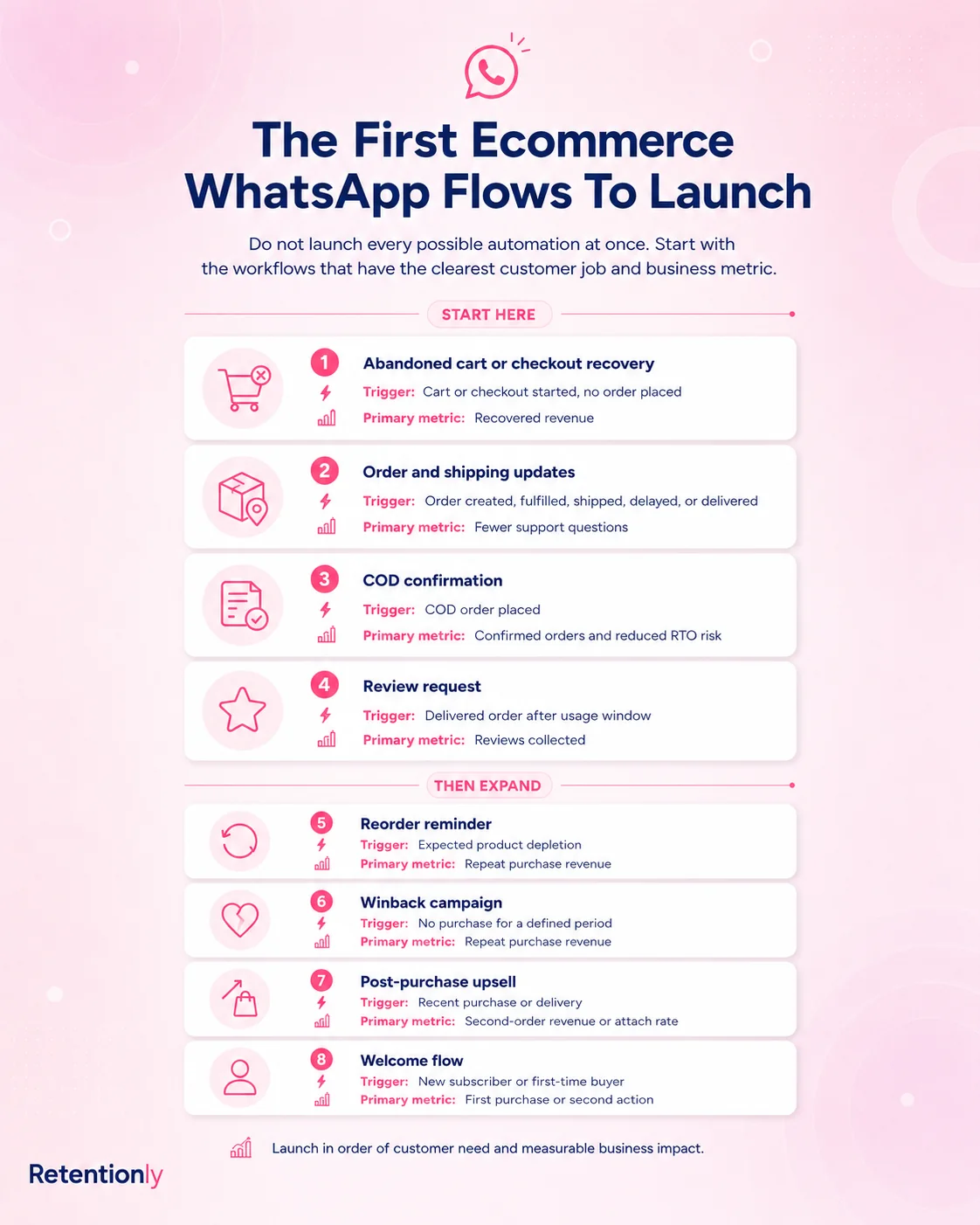
The point is not to automate everything at once. Start with the moments where WhatsApp has a clear job and the customer has a clear reason to care.
Better Offer Framing Can Beat Bigger Discounts
Many retention campaigns default to one move: a percentage discount. That can work, but it can also train customers to wait for the next deal.
The same commercial value can feel different depending on how it is framed.
| Weak framing | Better framing | Why it can work |
|---|---|---|
| "33% off today" | "Buy 2, get 1 free" | Feels like added product value, not only price cutting |
| "Come back for 20% off" | "Restock your routine before you run out" | Connects the offer to the customer's need |
| "Use code SAVE15" | "Your refill bundle is ready" | Makes the next action obvious |
| "Last chance sale" | "Members get early access to the next drop" | Gives a reason beyond urgency |
This does not mean discounts are bad. It means the offer should support the retention goal.
For a consumable product, a bundle may be better than a flat discount. For a beauty or wellness product, a routine-based offer may be better than a generic coupon. For a high-value repeat customer, early access may protect margin better than another markdown.
Subscription Retention Needs Three Things To Align
Subscription retention is not only an email or WhatsApp problem. Messaging helps, but the subscription itself must fit how customers actually use the product.
Three things need to align:
| Subscription part | What can go wrong | What to improve |
|---|---|---|
| Usage | The customer does not experience enough value before the next charge | Send onboarding, usage tips, and result check-ins early |
| Quantity | The customer has too much or too little product | Offer quantity choices, bundles, and easy adjustments |
| Billing cadence | The next charge arrives too soon or too often | Match cadence to real consumption and reduce surprise |
A 30-day subscription can be hard to retain if the product lasts longer than 30 days. The customer sees a billing reminder before they feel ready to reorder, and that reminder becomes a cancellation prompt.
When the product supports it, longer cycles or multi-pack offers can reduce friction. A 90-day bundle, refill pack, or prepaid subscription can create more cash up front and fewer cancellation reminders. But this only works when the quantity and usage pattern make sense.
WhatsApp should support the cadence with helpful messages:
Before the first renewal, check whether the customer is using the product correctly.
Before a reorder moment, remind them what they bought and why it matters.
Before a billing event, make adjustment easy instead of hiding the option.
After a skipped or canceled subscription, ask for the real reason and route the customer to a better fit.
Retention improves when the product experience, offer, and message timing work together.
Practical Gifts Beat Flashy Perks
Many brands try to improve retention with branded merchandise, broad loyalty perks, or surprise gifts that look good in a campaign plan but do not change the product experience.
The better question is: what gift makes the product easier to use, easier to remember, or easier to reorder?
Examples:
| Product category | Practical retention gift | Why it helps |
|---|---|---|
| Supplements | Travel pouch, dosage card, routine tracker | Helps the customer keep the habit |
| Skincare | Applicator, mini routine guide, product pairing card | Reduces usage confusion |
| Coffee or tea | Scoop, brew card, sampler refill | Improves daily use and discovery |
| Pet care | Feeding guide, refill reminder, size-based bundle | Supports repeat need |
| Apparel | Care guide, styling suggestion, fit support | Reduces regret and returns |
The same rule applies to WhatsApp messages. Do not send a message because the brand wants attention. Send it because it makes the customer's next step easier.
Ask Better Questions On Day 14
Day 14 is often a useful point for a light check-in. The customer has usually received the product, tried it, and formed an early opinion.
The mistake is asking a harsh yes-or-no question that creates a dead end.
Instead of:
| Avoid | Use |
|---|---|
| "Did you like it? Yes or No" | "Have you started seeing the result you expected?" |
| "Are you satisfied?" | "What would help you get more from it?" |
| "Do you want to buy again?" | "Do you want a reminder before you run out?" |
Give customers a path that keeps the relationship alive.
For example, a simple check-in can say:
Hi [first_name], quick check-in from [store_name]. Have you started seeing the result you expected from [product_name]?
Reply 1 for "Yes, it is working".
Reply 2 for "I need more time".
Reply 3 for "I need help".
The "yes" group can receive a review request, reorder reminder, bundle offer, or referral message later. The "need more time" group can receive a helpful usage tip. The "need help" group should go to support before any promotion.
That is retention. It is not only pushing the next sale. It is learning what should happen next.
Build A Shopify WhatsApp Retention Map
A retention map turns scattered messages into a system. It shows which customer moment starts a flow, what the message should do, when to stop, and what metric proves the flow is worth keeping.
| Retention moment | Shopify trigger | WhatsApp message job | Stop rule | Metric |
|---|---|---|---|---|
| Abandoned checkout | Checkout started, no purchase | Recover the order with context | Purchase, opt-out, expired checkout | Recovered revenue |
| COD confirmation | COD order created | Confirm intent before fulfillment | Confirmed, canceled, no response | Confirmed orders, RTO reduction |
| Delivery update | Fulfillment or tracking update | Reduce uncertainty | Delivered, support issue, opt-out | Fewer WISMO questions |
| First usage help | Delivered order plus delay | Improve product experience | Reply, support issue, next flow | Positive replies, lower refunds |
| Review request | Delivered plus usage window | Collect social proof | Review submitted, negative reply | Review rate |
| Reorder reminder | Expected replenishment window | Drive repeat purchase | New order, opt-out, wrong timing reply | Repeat purchase revenue |
| Winback | No order after inactivity window | Bring back the right segment | Purchase, opt-out, support issue | Revenue per recipient |
| VIP or loyalty nudge | Repeat order threshold | Protect high-value customers | Purchase, claimed benefit, opt-out | Repeat revenue, retention rate |
Each row should have a reason to exist. If a flow does not have a clear trigger, stop rule, and success metric, it will be hard to improve.
What To Automate First
Start with the retention flows closest to customer behavior and revenue.
For most Shopify stores, the launch order should be:
Abandoned checkout recovery.
Order and shipping updates.
COD confirmation, if the store uses COD.
Review request after delivery.
Reorder reminder or replenishment flow.
Winback campaign for inactive buyers.
Post-purchase upsell or bundle offer.
Loyalty, VIP, or subscription retention messages.
Do not add all eight at once if the team cannot manage replies, support handoffs, and reporting. A small number of clean flows will usually beat a messy automation map that sends too many messages.
How Retentionly Fits
Retentionly is built for Shopify stores that want WhatsApp automation tied to retention and repeat revenue.
Instead of starting from a generic broadcast tool, Retentionly helps merchants build flows around Shopify events: abandoned checkouts, orders, delivery moments, reviews, reorders, winbacks, upsells, and repeat purchase campaigns.
That matters because customer retention is not one campaign. It is a sequence of moments. The first order needs trust. The second order needs a reason. The fourth order may need convenience. The best customers need recognition without over-messaging.
Install Retentionly free on Shopify if you want WhatsApp retention workflows that help customers buy again, not just another place to send discounts.
FAQ
Can WhatsApp improve Shopify customer retention?
Yes, when WhatsApp is tied to real lifecycle moments such as abandoned checkout, delivery updates, review requests, reorders, winback campaigns, and post-purchase support. It is weaker when used only as a generic broadcast channel.
What is the best first retention flow for Shopify?
For many stores, the best first retention flow is post-purchase onboarding: order updates, delivery support, product usage help, and a review or reorder path. If checkout abandonment is high, abandoned checkout recovery may be the first revenue flow to launch.
How often should Shopify stores message customers on WhatsApp?
There is no universal frequency. Message when there is a clear customer reason: an order update, a replenishment window, a support need, a review moment, or a relevant return offer. If messages are not tied to customer behavior, frequency will feel too high quickly.
Should retention campaigns always include discounts?
No. Discounts can help, but offer framing, bundles, replenishment reminders, early access, loyalty perks, and practical product help can often protect margin better than a generic percentage-off campaign.
What should Shopify stores measure for WhatsApp retention?
Measure recovered revenue, second purchase rate, repeat purchase revenue, reorder conversion, winback revenue per recipient, review rate, support replies, opt-outs, and negative replies. Delivery and read rates are useful, but they do not prove retention by themselves.