Klaviyo WhatsApp Shopify Guide: How to Split Email and WhatsApp
TL;DRKlaviyo is often the email and SMS backbone for Shopify stores. That does not mean WhatsApp should become a copy of the same campaign calendar. The better question is: which customer moments deserve email, which deserve WhatsApp, and which need both with clear timing rules?
For Shopify teams, the cleanest split is simple. Keep Klaviyo strong for email, owned list growth, longer lifecycle education, segmentation, and broad campaign orchestration. Use WhatsApp for the moments where speed, visibility, customer intent, and replies matter more: abandoned checkout recovery, COD confirmation, urgent order updates, review requests, winback nudges, replenishment reminders, and post-purchase upsells.
This guide shows how to plan a Klaviyo and WhatsApp stack for Shopify without duplicating messages, confusing opt-ins, or turning WhatsApp into another bulk channel.
Quick Verdict: Do You Need WhatsApp If You Already Use Klaviyo?
You may not need a separate WhatsApp strategy if Klaviyo already covers every customer moment you care about and your store does not rely on urgent follow-up, COD orders, high-intent cart recovery, or repeat purchase nudges.
Most growing Shopify stores are not in that situation.
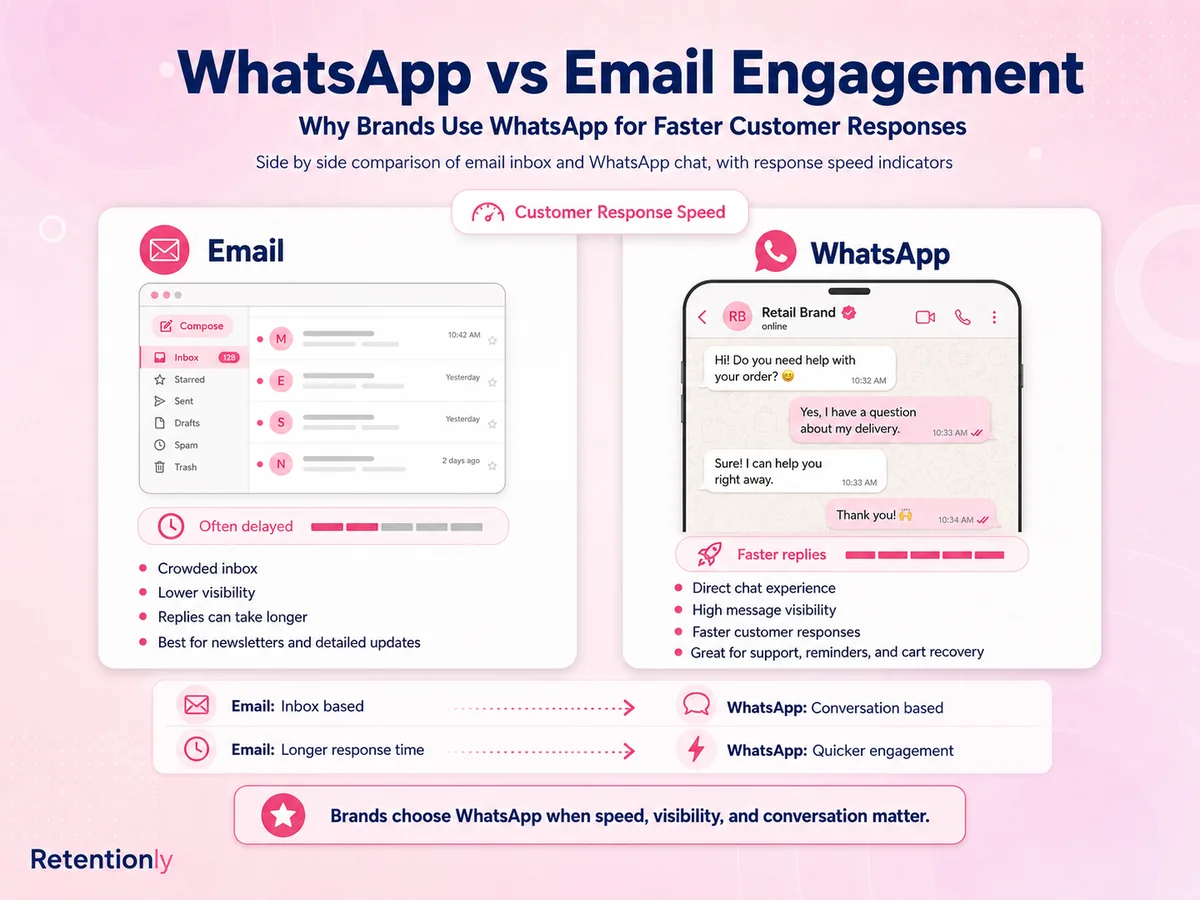
Email is still useful for stories, product education, launches, loyalty updates, newsletters, and longer purchase cycles. WhatsApp is useful when the message should feel immediate, personal, and easy to answer. If a customer abandoned checkout 45 minutes ago, a short WhatsApp reminder with a checkout link can do a different job than an email. If a COD order needs confirmation before fulfillment, WhatsApp is better suited to a fast yes/no reply than a polished email flow.
The goal is not to move every Klaviyo flow to WhatsApp. The goal is to give each channel a job.
Klaviyo vs WhatsApp For Shopify Retention
Klaviyo and WhatsApp are not direct substitutes. Klaviyo is a marketing automation and customer data platform used heavily by ecommerce teams. WhatsApp is a high-attention messaging channel. A Shopify WhatsApp app like Retentionly sits closer to store events and revenue workflows, turning Shopify triggers into WhatsApp messages.
| Decision area | Klaviyo email and SMS | Shopify WhatsApp automation |
|---|---|---|
| Best channel role | Owned lifecycle marketing and campaign orchestration | Fast, conversational retention moments |
| Strongest use cases | Welcome series, education, launches, browse/cart email flows, newsletters, segmentation | Abandoned checkout, COD confirmation, order updates, review requests, winback, reorders, post-purchase upsell |
| Message length | Better for richer content and explanation | Better for short action-oriented messages |
| Customer action | Click, browse, buy later | Reply, confirm, resume checkout, reorder, review |
| Team ownership | Email, SMS, CRM, lifecycle marketing | Retention, ecommerce operations, WhatsApp revenue workflows |
| Risk if overused | Inbox fatigue and lower engagement | Blocks, opt-outs, and brand trust loss |
| Best metric | Revenue per recipient, email engagement, campaign contribution, lifecycle conversion | Recovered revenue, confirmed COD orders, repeat purchases, review rate, support deflection |
This is why the decision should not be "Klaviyo or WhatsApp." It should be "Klaviyo for the moments email handles well, WhatsApp for the moments where Shopify intent is fresh and action should be immediate."
The Channel Split That Works Best
Start by mapping each Shopify customer moment to a primary channel.
| Customer moment | Primary channel | Why |
|---|---|---|
| New subscriber welcome | Email first, WhatsApp optional | Email can carry brand story, product range, and education without feeling intrusive |
| Checkout abandoned | WhatsApp first for opted-in shoppers, email fallback | The shopper has recent intent and a short message can reopen the buying path |
| COD order created | WhatsApp first | The business needs a quick confirmation before fulfillment |
| Order placed | Email plus WhatsApp for high-value or anxious categories | Email works as record, WhatsApp works for immediate reassurance |
| Shipping or delivery update | WhatsApp for important updates, email for full details | WhatsApp reduces "where is my order" anxiety when timing matters |
| Review request | WhatsApp after delivery window | A short prompt can get a faster response than another post-purchase email |
| Replenishment due | WhatsApp for consumables, email for broader product education | The customer needs a timely reorder path, not a long campaign |
| Winback | Email first, WhatsApp for high-intent or high-value segments | Email can test interest; WhatsApp should be reserved for customers worth a personal nudge |
| Product launch | Email first, WhatsApp for VIP or waitlist segments | WhatsApp should not blast the whole list unless the audience is narrow and relevant |
The practical rule: use email when the message needs space, context, and repeated exposure. Use WhatsApp when the customer is already close to action.
A Shopify Flow Map For Klaviyo And WhatsApp
Here is a simple operating map for a Shopify store using Klaviyo and WhatsApp together.
| Flow | Klaviyo job | WhatsApp job | Stop rule |
|---|---|---|---|
| Welcome | Tell the brand story, educate, collect preferences | Confirm WhatsApp opt-in or send first high-value offer only when consent is clear | Stop WhatsApp if customer does not opt in |
| Abandoned checkout | Send richer reminder, product benefits, social proof | Send short checkout recovery message with direct link | Stop both channels after purchase |
| COD confirmation | Usually not the primary channel | Ask customer to confirm, cancel, or edit the order before fulfillment | Stop after confirmation, cancellation, prepaid conversion, or timeout |
| Order updates | Send official receipt and details | Send key status updates and reduce support replies | Stop after delivery or issue resolution |
| Review request | Send longer review education or loyalty context | Ask for the review at the right post-delivery moment | Stop after review submitted or request window closes |
| Reorder | Educate with usage tips and product benefits | Send a timely reorder reminder near expected depletion | Stop after reorder or if customer declines |
| Winback | Test interest with a segment-based email offer | Send a focused WhatsApp nudge to high-value inactive customers | Stop after purchase, opt-out, or campaign window |
| Post-purchase upsell | Explain complementary products | Send one contextual next-step recommendation | Stop if customer buys, returns, or is inside a cooling-off period |
This map prevents the most common mistake: sending the same discount across email, SMS, and WhatsApp on the same day. That does not create omnichannel marketing. It creates repetition.
What Should Stay In Klaviyo
Klaviyo should usually remain the home for deeper lifecycle marketing.
Keep these flows and campaigns in Klaviyo:
Brand welcome series with education, proof, and product discovery.
Category education and product comparison emails.
Newsletter and content-led campaigns.
Seasonal launch campaigns that need visuals and narrative.
Large audience segmentation and preference-based campaigns.
Email deliverability, list hygiene, and suppression management.
Longer post-purchase education sequences.
This is not a weakness. Email is still the better channel when the customer needs time to read, compare, or come back later. A skincare brand can explain routine order, ingredients, and expected results in email. A fashion brand can show a full collection. A supplements brand can educate over several messages.
WhatsApp should not carry all of that. It should carry the short, timely messages that benefit from immediacy.
What Should Move To WhatsApp
Move the moments that are closer to action.
For Shopify stores, the strongest WhatsApp candidates are:
| Workflow | WhatsApp message job | Metric to watch |
|---|---|---|
| Abandoned checkout | Bring the shopper back to the exact checkout | Recovered checkout revenue |
| COD confirmation | Confirm intent before the order is packed | Confirmed COD rate, cancellation rate, RTO risk |
| Order status update | Reduce uncertainty after purchase | Support tickets, reply rate, delivery-related complaints |
| Review request | Ask after delivery when the customer can judge the product | Review rate |
| Reorder reminder | Make repeat purchase easy at the right time | Repeat purchase revenue |
| Winback | Bring back valuable inactive customers | Reactivation revenue |
| Post-purchase upsell | Recommend a logical next product | Upsell conversion |
Retentionly is built around this kind of Shopify WhatsApp retention automation. It is not trying to replace a full email marketing platform. It gives Shopify teams a focused way to run WhatsApp flows from ecommerce events without making WhatsApp depend on a generic campaign calendar.
How To Avoid Overlapping Messages
Channel overlap is the main risk when a store adds WhatsApp on top of Klaviyo.
The fix is to define order, timing, and exclusion rules before launching.
| Rule | Example |
|---|---|
| Set a primary channel per flow | Abandoned checkout first nudge goes to WhatsApp for opted-in shoppers; email follows only if no purchase |
| Avoid same-day duplication | Do not send the same offer by email and WhatsApp within minutes unless the customer is in a high-intent recovery flow |
| Use customer state | Suppress WhatsApp if the customer already purchased, canceled, reviewed, or opted out |
| Respect cooling-off windows | Do not send upsell, review, and winback messages too close together |
| Separate campaign and automation logic | A sale broadcast should not interrupt COD confirmation or order update flows |
If Klaviyo sends an abandoned checkout email at hour one and WhatsApp sends a recovery message at the same time, one of them is probably redundant. Instead, decide the sequence. For example, WhatsApp at 45 minutes for opted-in shoppers, email after a few hours for everyone else, and a final email the next day if the cart remains open.
Example: Abandoned Checkout Split
Abandoned checkout is the easiest place to see the difference.
| Step | Channel | Timing | Message job |
|---|---|---|---|
| 1 | 30-60 minutes after checkout abandonment | Bring the shopper back while intent is fresh | |
| 2 | 3-6 hours later | Add product benefits, social proof, and a fuller reminder | |
| 3 | WhatsApp or email | 20-24 hours later | Use only if the cart is still open and the customer has not opted out |
A WhatsApp message for this flow should be short:
Hi [first name], you left a few items in your cart. Want to continue checkout? [checkout link]
The email can do a different job: explain benefits, include product photos, answer objections, and show reviews. If both messages say the same thing, the stack is not planned well enough.
Example: COD Confirmation Split
COD confirmation is where WhatsApp often deserves ownership.
Email is usually too slow for this workflow. The store needs to know whether the order is real before picking, packing, and shipping. WhatsApp can ask the customer to confirm or cancel in a reply-friendly format.
| COD state | WhatsApp action | Shopify team action |
|---|---|---|
| COD order placed | Ask the customer to confirm the order | Hold fulfillment until confirmation or timeout |
| Customer confirms | Mark order ready for fulfillment | Ship with more confidence |
| Customer cancels | Stop fulfillment | Save shipping and handling cost |
| No response | Send one reminder or flag for manual review | Avoid blindly shipping risky orders |
Klaviyo can still hold broader post-purchase education and lifecycle campaigns. But the actual COD confirmation step belongs in the fastest channel the customer is likely to answer.
Example: Reorder And Winback Split
Reorder reminders and winback campaigns need more discipline because they can easily become spammy.
Use Klaviyo to identify the broader lifecycle segment: customers who bought a consumable 25 days ago, buyers who have not ordered in 60 days, or VIP customers who missed the last launch. Then use WhatsApp only when the customer moment is specific enough.
| Scenario | Better email job | Better WhatsApp job |
|---|---|---|
| Replenishable product | Explain usage tips and benefits over time | Send a short reorder reminder near depletion |
| Lapsed customer | Reintroduce the brand and show new arrivals | Send one focused nudge to high-value inactive customers |
| VIP launch | Show collection story and full launch details | Give early-access customers a direct buying link |
The more personal the channel, the narrower the audience should be.
Setup Checklist For Shopify Teams
Before adding WhatsApp to a Klaviyo-heavy Shopify stack, define these items.
| Checklist item | Why it matters |
|---|---|
| WhatsApp consent source | You need clear permission before sending WhatsApp marketing messages |
| Primary flows | Start with 2-3 high-intent workflows instead of copying every email flow |
| Channel sequence | Decide whether WhatsApp or email sends first for each flow |
| Suppression rules | Stop messages after purchase, opt-out, cancellation, review, refund, or customer reply |
| Reply ownership | Decide who handles customer replies and when support gets involved |
| Metrics | Track revenue and workflow outcomes, not only sends and clicks |
| Frequency cap | Protect the channel from becoming another broadcast list |
Do not launch WhatsApp as "Klaviyo, but shorter." Launch it as a retention workflow layer with its own job.
Where Retentionly Fits
Retentionly fits when a Shopify team already has email handled but wants WhatsApp to own revenue and retention workflows.
Use Retentionly when you want to:
Recover abandoned checkouts with WhatsApp messages tied to Shopify intent.
Confirm COD orders before fulfillment.
Send order and shipping updates customers are more likely to notice.
Request reviews after delivery.
Trigger reorder, winback, and upsell messages from customer behavior.
Keep WhatsApp focused on retention instead of broad broadcast volume.
If your team wants one broad marketing suite for email, SMS, WhatsApp, service, analytics, and customer data, Klaviyo's expanding WhatsApp product may be worth evaluating directly. If your team wants to keep Klaviyo for email and add a Shopify-first WhatsApp automation layer, Retentionly is the more focused fit.
Common Mistakes
The first mistake is copying email flows into WhatsApp without changing the message job. WhatsApp should not carry long product education sequences or repeated promotions.
The second mistake is ignoring replies. If customers can respond on WhatsApp, someone or some workflow needs to own those replies. A COD confirmation reply, delivery question, or product objection should not disappear into a campaign report.
The third mistake is measuring only clicks. For Shopify WhatsApp automation, the better metrics are recovered revenue, confirmed orders, review rate, repeat purchase revenue, winback revenue, and reduced support load.
The fourth mistake is sending to too many people. WhatsApp works best when the audience is narrow and the customer moment is clear.
Final Recommendation
Keep Klaviyo as the email and lifecycle marketing backbone if it is already working for your Shopify store. Add WhatsApp where the customer moment is urgent, high-intent, or reply-friendly.
The clean split is:
| Use Klaviyo for | Use WhatsApp for |
|---|---|
| Long-form education | Fast action |
| Broad campaigns | Narrow, high-intent segments |
| Email-first lifecycle nurturing | Shopify-triggered retention flows |
| Product storytelling | Checkout, confirmation, update, review, reorder, and winback moments |
That gives each channel a clear role. Klaviyo helps you keep the customer relationship warm. WhatsApp helps you act when the customer is closest to buying, confirming, replying, or returning.
If you want that WhatsApp layer built around Shopify retention workflows, install Retentionly and start with one flow: abandoned checkout recovery, COD confirmation, order updates, review requests, reorder reminders, or winback. Launch the workflow with clear timing, stop rules, and one metric that proves whether it is working.
Quick FAQ
Can Klaviyo send WhatsApp messages?
Klaviyo has WhatsApp product and help-center resources for WhatsApp setup, consent, forms, segments, billing, deliverability, and messaging. Shopify teams should verify current availability, supported countries, billing, and feature fit inside Klaviyo before relying on it as their WhatsApp channel.
Should Shopify stores replace Klaviyo with WhatsApp?
Usually no. Klaviyo can remain the email and lifecycle marketing system. WhatsApp should be added for moments where immediacy and replies matter more than long-form content.
What WhatsApp flow should a Klaviyo-heavy Shopify store launch first?
Start with abandoned checkout if revenue recovery is the priority. Start with COD confirmation if fulfillment risk and RTO are the priority. Start with order updates if support load is the priority.
Should the same campaign go out on email and WhatsApp?
Not by default. Email can reach a wider audience with more context. WhatsApp should usually go to a narrower segment with a clearer reason to act.
How does Retentionly fit with Klaviyo?
Retentionly can sit alongside Klaviyo as a Shopify-first WhatsApp automation layer. Klaviyo continues handling email and lifecycle campaigns, while Retentionly handles WhatsApp retention workflows triggered by Shopify customer and order behavior.