Best Gupshup Alternative for WhatsApp Automation
TL;DRIf you are looking for a Gupshup alternative, you are probably not deciding whether WhatsApp belongs in your customer stack. You are deciding what kind of WhatsApp system should own the work: a broad API and conversational engagement platform, or a Shopify-first automation app built around retention revenue.
Gupshup is a serious platform. Its current public positioning spans WhatsApp Business API access, conversational AI, campaign orchestration, agent handoff, omnichannel messaging, ecommerce use cases, and custom integrations. That can make sense when WhatsApp is part of a larger customer engagement architecture across marketing, sales, support, and operations.
But many Shopify founders, marketers, and ecommerce managers have a narrower buying job. They want abandoned checkout recovery, COD confirmation, order updates, review requests, winback campaigns, post-purchase upsells, and repeat purchase reminders to work without building a broad API program first. That is where Retentionly is the sharper Gupshup alternative.
Quick Verdict
Choose Gupshup if you want a broad WhatsApp Business API, CPaaS, conversational AI, and omnichannel messaging platform that can be shaped around many teams, channels, and custom workflows.
Choose Retentionly if your main goal is Shopify WhatsApp retention automation: lifecycle flows that recover lost revenue, reduce operational friction, and bring customers back for another purchase.
| Best fit | Gupshup | Retentionly |
|---|---|---|
| Primary use case | Broad conversational engagement, WhatsApp API, AI agents, campaigns, and integrations | Shopify/D2C retention automation and lifecycle revenue workflows |
| Strongest buyer | Teams with platform, API, support, campaign, or enterprise engagement needs | Shopify founders, marketers, and ecommerce managers focused on repeat revenue |
| Core question | "How do we build and scale customer conversations across channels?" | "How do we automate the Shopify WhatsApp flows that drive revenue?" |
| Main advantage | Flexible platform breadth and API-led customization | Focused Shopify workflow ownership and clearer automation economics |
Pricing Comparison: Compare The Model Before The Tool
Do not compare a Gupshup alternative only by the first visible monthly price. The real pricing model can include the software subscription, Meta message fees, provider charges or markup, campaign volume, templates, contacts, agents, AI usage, integrations, setup support, and the cost of maintaining a custom workflow.
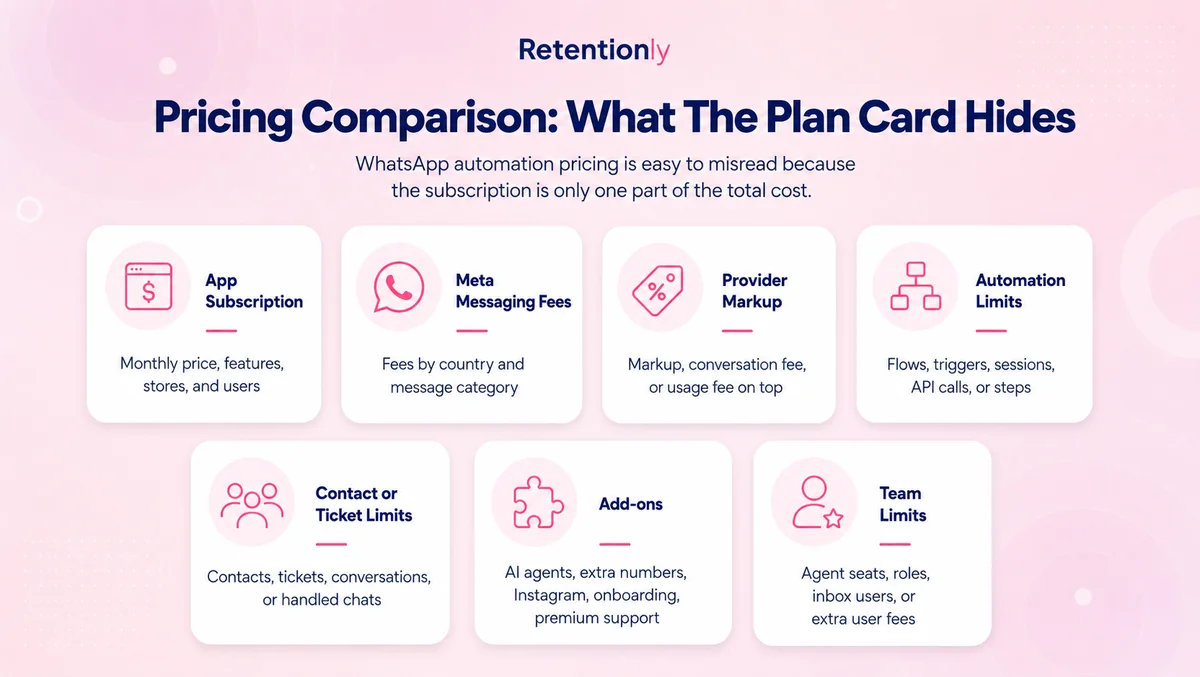
Gupshup should be evaluated like a platform. Buyers should verify current pricing directly, including WhatsApp Business API fees, any platform charges, message rates, campaign tooling, AI features, integration work, and support requirements. That does not make Gupshup a poor choice. It means the buyer should model the full operating cost, especially if the team needs a custom implementation.
Retentionly pricing is intentionally simpler:
| Retentionly plan | Price | Best for |
|---|---|---|
| Basic | $24/month | Basic automations and core features |
| Growth | $49/month | Broadcasts and advanced automations, including winback workflows |
| Scale | $99/month | CRM features and multi-agent chat |
Retentionly connects directly to Meta and does not add a markup on Meta messaging fees. It also does not charge extra for added automations and does not charge per-chat fees. For Shopify teams, that makes WhatsApp easier to forecast as automation volume grows.
| Pricing question | Gupshup | Retentionly |
|---|---|---|
| Base software cost | Buyer should verify the current platform, API, and feature package | Basic starts at $24/month |
| Meta message fees | Buyer should separate Meta fees from provider/platform costs | Meta rates apply with no Retentionly markup |
| API or implementation effort | Often relevant when the team wants a custom platform setup | App-led setup for Shopify retention workflows |
| Campaign and automation cost | Depends on chosen features, volume, integrations, and support model | No extra charge for added automations |
| Agent or support needs | Useful when WhatsApp is a cross-team support and sales channel | Scale includes CRM features and multi-agent chat |
| AI needs | Stronger fit when AI agents and custom conversation design are central | Evaluate AI only where it supports Shopify retention |
| Best pricing fit | Teams that need broad platform flexibility and can model total cost | Teams that want predictable Shopify retention automation economics |
The pricing takeaway is not "choose the cheapest option." The right question is which cost model matches the job. If your first goal is to launch revenue workflows from Shopify events, Retentionly is easier to evaluate. If your team needs a larger conversational infrastructure project, Gupshup may justify a broader cost model.
Feature Comparison
Gupshup and Retentionly both belong in the WhatsApp automation conversation, but they are organized around different jobs. Gupshup is a broad platform for messaging, APIs, AI, campaigns, and customer engagement. Retentionly is focused on Shopify-triggered retention workflows.
| Feature or buying criterion | Gupshup | Retentionly |
|---|---|---|
| WhatsApp Business API | Core part of the platform and BSP-led setup | Connected as part of Shopify automation setup |
| Shopify fit | Public pages mention Shopify and ecommerce use cases; buyer should verify exact workflow ownership | Built around Shopify and D2C retention workflows |
| Abandoned checkout recovery | Possible through API, campaigns, integrations, or custom journeys | Core revenue workflow |
| COD confirmation | Buyer should verify whether it is packaged or configured as a custom flow | Core Shopify/D2C workflow |
| Order updates | Supported as a WhatsApp API/ecommerce use case; setup path depends on implementation | Core lifecycle automation |
| Review requests | Possible through templates, triggers, and integrations | Designed as a post-purchase retention flow |
| Winback campaigns | Possible through segmentation, campaigns, and automation | Growth plan includes advanced automations such as winback |
| Post-purchase upsell | Possible through journeys, campaigns, and product data integrations | Built as a repeat revenue workflow |
| Reorder reminders | Possible with the right customer and order data setup | Built for repeat purchase timing |
| Shared inbox and handoff | Strong fit when support or sales teams need agent handoff | Available where needed, but not the center of the product |
| AI agents | Stronger broad-platform emphasis | Useful only where it supports retention workflow outcomes |
| Omnichannel messaging | Broader channel scope beyond WhatsApp | Focused on WhatsApp for Shopify retention |
| Setup complexity | Flexible, but may require more platform decisions | Designed for quicker Shopify workflow launch |
| Best-fit team | Teams with API, support, AI, campaign, or enterprise engagement needs | Shopify teams that want retention flows live without broad platform assembly |
The deciding question is not which product has more features. It is which product owns the workflows your store will actually run every week.
Shopify Workflow Comparison
A Shopify WhatsApp system should not stop at "can send messages." It should know why the message is being sent, when it should stop, what Shopify event triggered it, and what metric proves it worked.
| Workflow | What the workflow needs | Gupshup fit | Retentionly fit |
|---|---|---|---|
| Abandoned checkout | Checkout trigger, delay, recovery link, suppression after purchase, recovered revenue | Good if the team configures the event, template, and reporting path | Core flow built around revenue recovery |
| COD confirmation | Order trigger, confirm/cancel reply handling, fulfillment stop rules, RTO reduction metric | Possible through automation and integrations | Core flow for Shopify/D2C operations |
| Order updates | Order, shipping, delivery, and exception events | Good API use case if data wiring is handled | Core lifecycle automation |
| Review request | Delivery timing, product context, review link, suppression for support issues | Possible through templates and journeys | Built as a post-purchase retention moment |
| Winback | Last purchase date, customer segment, offer logic, frequency control, repeat purchase metric | Possible through segments and campaigns | Growth plan supports advanced retention automations |
| Post-purchase upsell | Purchase context, complementary offer, timing, stop rules, revenue tracking | Possible with product/order data setup | Built for repeat revenue workflows |
| Reorder reminder | Product replenishment timing, customer segment, reorder link, conversion tracking | Possible with custom data logic | Designed around repeat purchase timing |
This is where many Shopify teams should slow down. If the team already has developers, lifecycle operators, and a broader customer engagement roadmap, Gupshup can be a powerful platform. If the team wants the Shopify retention workflows packaged with fewer platform decisions, Retentionly is the more direct alternative.
Where Gupshup Is Strong
Gupshup is a stronger fit when WhatsApp is one part of a larger customer engagement platform. Its public positioning covers conversational AI, WhatsApp Business API access, campaigns, agent handoff, integrations, ecommerce use cases, support, and multiple messaging channels. That breadth matters when a team wants flexibility across many business functions.
It can also make sense when the business has internal ownership for APIs, campaign operations, data integrations, and custom conversation design. A platform approach gives teams more room to shape workflows around existing systems.
The tradeoff is focus. Shopify merchants still need to decide which flows matter first, who owns each trigger, which templates are required, how replies are handled, what stops the automation, and how success is measured. Without that discipline, a flexible platform can become a long setup project before the first retention flow pays back.
Where Retentionly Is Strong
Retentionly is stronger when the WhatsApp job is Shopify retention automation. The product is not trying to be a generic CPaaS layer for every channel and department. It is built around the lifecycle moments that matter to Shopify and D2C teams.
That focus matters because revenue workflows are operational, not theoretical. An abandoned checkout message needs the checkout link and a stop rule after purchase. A COD confirmation needs reply handling before fulfillment. A review request needs delivery timing. A winback campaign needs last purchase logic and frequency control. A reorder reminder needs product timing, not just a broadcast list.
Retentionly is also easier to reason about when pricing clarity matters. The plan structure is simple, Retentionly does not add markup on Meta messaging fees, and it does not charge extra for added automations or per-chat usage. For a Shopify team trying to scale WhatsApp from a few flows into a retention channel, that clarity is part of the product value.
Setup And Team Fit
Gupshup usually fits teams that are comfortable making platform decisions. They may need WhatsApp API access, AI agents, campaigns, live-agent handoff, multiple channels, CRM or support integrations, and custom workflows across regions or departments. The buying process should include implementation ownership, support model, message categories, data flows, and pricing assumptions.
Retentionly fits teams that want a more direct path from Shopify events to WhatsApp revenue flows. The team does not need to start by designing a messaging architecture. It can start with the workflows that matter most: abandoned checkout, COD confirmation, order updates, reviews, winback, upsells, and reorders.
| Team situation | Better fit |
|---|---|
| You need a broad messaging API platform across channels | Gupshup |
| You need WhatsApp AI agents and custom conversation design across teams | Gupshup |
| You want to launch Shopify abandoned checkout and retention flows quickly | Retentionly |
| You want pricing that is easy to forecast as automation volume grows | Retentionly |
| Your support, sales, marketing, and operations teams all need one broad engagement layer | Gupshup |
| Your Shopify marketing team owns lifecycle revenue and repeat purchases | Retentionly |
When Gupshup Is Still The Better Fit
Gupshup is still the better fit when the business wants a broad WhatsApp Business API and conversational AI platform. If you are building custom flows across WhatsApp, SMS, RCS, Instagram, support teams, campaigns, and enterprise systems, a platform can be the right choice.
It is also the better option when the team has the resources to define custom architecture, maintain integrations, test conversation paths, and manage API-led implementation details. For some brands, that flexibility is the point.
Choose Gupshup when your WhatsApp need is bigger than Shopify retention and your team is ready to own the platform decisions that come with that breadth.
When Retentionly Is The Better Gupshup Alternative
Retentionly is the better Gupshup alternative when your main job is Shopify retention.
That means you are not trying to build a general conversational platform first. You are trying to recover abandoned checkouts, confirm COD orders, send useful order updates, collect reviews, win back lapsed customers, create post-purchase upsells, and bring customers back for repeat purchases.
It is also the better fit when the team wants simpler economics. Retentionly gives you clear plans, no Retentionly markup on Meta messaging fees, no extra charge for added automations, and no per-chat fees. That makes it easier to connect WhatsApp cost to Shopify revenue.
If you are comparing Gupshup alternatives because your real goal is Shopify retention and D2C repeat revenue, start with the workflow list. The right tool is the one that can own those flows with the least friction.
Final Recommendation
If your company needs a broad API, AI, and omnichannel customer engagement platform, evaluate Gupshup seriously. It is built for a wider job than a single Shopify automation app.
If your Shopify team mainly needs WhatsApp automation for retention revenue, Retentionly is the more focused alternative. It gives you simpler setup, clearer pricing, and workflows built around the lifecycle moments that move ecommerce revenue.
Install Retentionly free on Shopify and start with one flow that can prove value: abandoned checkout recovery, COD confirmation, order updates, reviews, winback, upsell, or reorder reminders.
Quick FAQ
What is the best Gupshup alternative for Shopify stores?
Retentionly is a strong Gupshup alternative for Shopify stores that want WhatsApp retention automation rather than a broad API platform. It focuses on abandoned checkout recovery, COD confirmation, order updates, reviews, winback, upsells, and repeat purchases.
Is Gupshup good for ecommerce?
Yes. Gupshup covers ecommerce and WhatsApp Business API use cases such as promotions, abandoned cart alerts, order updates, agent handoff, campaigns, and integrations. The key question is whether your team wants a broad platform or a packaged Shopify retention automation app.
Why would a Shopify merchant choose Retentionly over Gupshup?
A Shopify merchant may choose Retentionly when the main goal is to launch revenue workflows quickly, keep pricing easier to forecast, and avoid building custom WhatsApp automation logic from a broad platform.
Does Retentionly replace every Gupshup use case?
No. Retentionly is a Gupshup alternative for Shopify retention use cases. It is not trying to replace every Gupshup workflow around CPaaS, omnichannel messaging, AI agents, enterprise support, or API-first custom implementation.
What should I compare before choosing a Gupshup alternative?
Compare the first workflows you need, not only the feature list. For Shopify, check abandoned checkout, COD confirmation, order updates, reviews, winback, post-purchase upsell, reorder reminders, Meta message fees, provider markup, setup effort, and who owns the workflow after launch.