Gorgias WhatsApp Shopify Guide for Support and Retention
TL;DRGorgias is a strong Shopify helpdesk when the job is support: tickets, customer context, order actions, macros, AI assistance, and agent workflows. WhatsApp can also be part of that support layer. But Shopify teams often run into a different question: should WhatsApp live inside the helpdesk, or should it also have a dedicated retention automation layer?
The answer depends on the customer moment. Use Gorgias when the customer has a support issue that needs context and a reply owner. Use Retentionly when WhatsApp should trigger from Shopify behavior and drive revenue outcomes such as abandoned checkout recovery, COD confirmation, order updates, reviews, reorders, winback, and post-purchase upsells.
This guide shows how to split Gorgias and WhatsApp for Shopify without duplicating messages, losing replies, or turning WhatsApp into another generic support queue.
Quick Verdict: Should WhatsApp Sit Inside Gorgias Or Retentionly?
Use Gorgias for WhatsApp when the message is part of a support conversation. That includes delivery questions, returns, refunds, product questions, exchanges, complaints, and cases where an agent needs Shopify order context before replying.
Use Retentionly for WhatsApp when the message is a Shopify-triggered retention workflow. That includes abandoned checkout recovery, COD confirmation, order and shipping updates, review requests, reorder reminders, winback campaigns, and post-purchase upsells.
Most growing Shopify brands should not treat this as one tool replacing the other. The cleaner setup is role-based:
| Layer | Best job |
|---|---|
| Gorgias | Centralize support conversations, tickets, agent workflows, order context, and issue resolution |
| Retentionly | Run Shopify WhatsApp retention automations tied to checkout, order, customer, and purchase behavior |
| Shopify | Source of truth for customers, orders, products, fulfillment, and purchase history |
| Team owner | Handle replies, exceptions, cancellations, complaints, and support handoff |
The deciding question is simple: is this WhatsApp message mainly a support response or a retention action?
Gorgias vs Retentionly For Shopify WhatsApp
Gorgias and Retentionly solve different parts of the Shopify customer journey.
Gorgias is built around ecommerce support. It helps teams view customer and order data in the ticket view, manage Shopify orders from the helpdesk, centralize customer channels, use macros and rules, and measure support operations. That is valuable when WhatsApp replies become customer service conversations.
Retentionly is built around Shopify WhatsApp retention automation. It is closer to the revenue moments that happen before and after purchase: checkout recovery, COD confirmation, delivery updates, review requests, reorder timing, winback, and upsell messages.
| Decision area | Gorgias | Retentionly |
|---|---|---|
| Primary job | Ecommerce helpdesk and support operations | Shopify WhatsApp retention automation |
| Best WhatsApp use | Customer support replies and agent-owned conversations | Automated retention flows from Shopify behavior |
| Shopify context | Useful inside tickets and customer profiles | Used to trigger and personalize lifecycle workflows |
| Team owner | Support, CX, service operations | Retention, ecommerce, lifecycle marketing, operations |
| Strongest metrics | Ticket volume, response time, resolution time, support automation, converted tickets | Recovered revenue, confirmed COD orders, delivery engagement, review rate, repeat purchase revenue |
| Risk if misused | Marketing messages can become support noise | Replies need a clear handoff owner |
| Best fit | Brands that need a central helpdesk for customer issues | Brands that want WhatsApp tied to repeat revenue and Shopify lifecycle moments |
The products can work together conceptually. Gorgias can own the conversations that need support context. Retentionly can own the WhatsApp flows that should happen because a Shopify customer, order, checkout, or segment changed state.
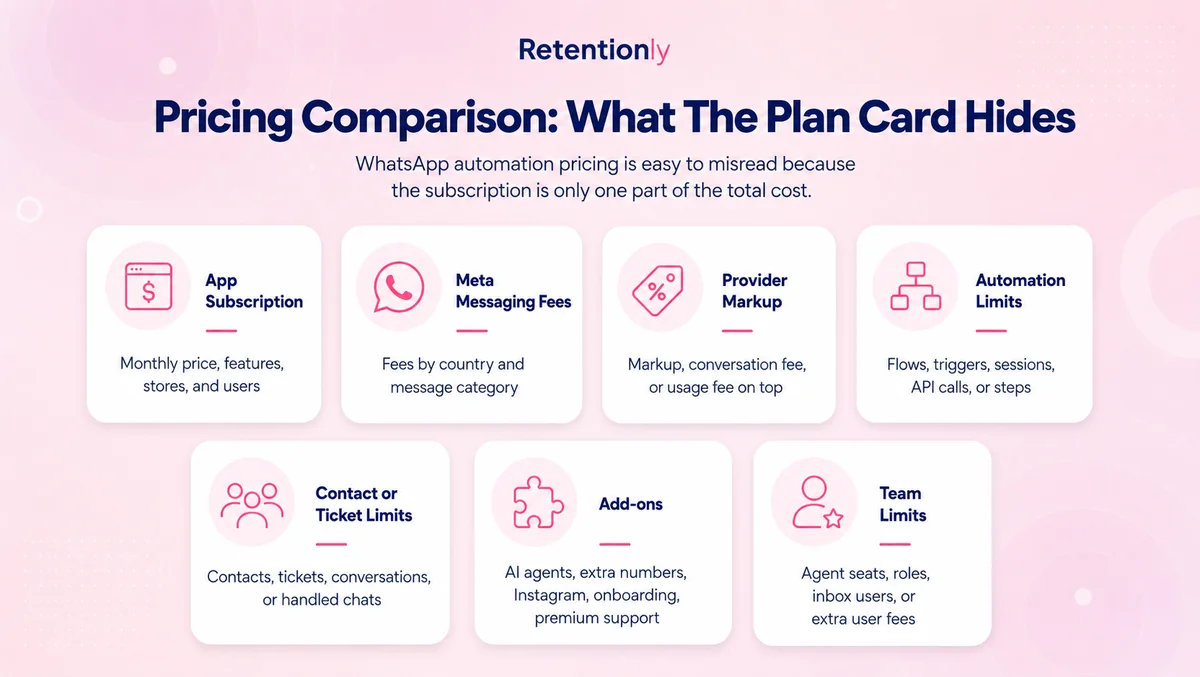
Pricing And Cost Model To Compare
Pricing should be compared by operating model, not only by starting price.
As of July 2026, Gorgias prices Helpdesk plus AI Agent with ticket limits and automated interaction limits. Public pricing shows plans starting at Starter, then Basic, Pro, Advanced, and Enterprise, with overage costs when ticket limits or automated interaction limits are exceeded. Gorgias also lists Voice and SMS as add-ons when needed.
Retentionly pricing is simpler for WhatsApp retention workflows:
| Cost area | Gorgias | Retentionly |
|---|---|---|
| Subscription model | Helpdesk plus AI Agent plans based on ticket and automation volume | Basic $24/month, Growth $49/month, Scale $99/month |
| Primary volume unit | Tickets and automated interactions | Plan features and WhatsApp automation use |
| WhatsApp economics | Verify current channel and messaging costs before choosing | Connects directly to Meta and does not add markup on Meta messaging fees |
| Automations | Included according to plan and product limits | No extra charge for added automations |
| Team expansion | Gorgias says Helpdesk is not priced per agent on current public pricing | Scale plan includes CRM features and multi-agent chat |
| Best cost fit | Teams budgeting for a full support suite | Teams budgeting for Shopify WhatsApp retention revenue workflows |
If support is the main problem, Gorgias pricing can make sense because the helpdesk becomes the team's operating center. If WhatsApp retention is the main problem, paying for a broad helpdesk just to run abandoned checkout, COD, review, reorder, and winback flows may be more stack than the workflow needs.
Which WhatsApp Workflows Belong In Each Tool?
The easiest way to avoid overlap is to map each workflow by intent.
| Shopify moment | Better owner | Why |
|---|---|---|
| Customer asks "Where is my order?" | Gorgias | It is an inbound support question that may need order context and an agent reply |
| Customer complains about delivery, refund, exchange, or product issue | Gorgias | The team needs ticket history, macros, tags, and escalation |
| Abandoned checkout | Retentionly | The customer showed buying intent and needs a direct recovery path |
| COD order created | Retentionly | The store needs a fast confirm/cancel reply before fulfillment |
| Shipping or delivery update | Retentionly first, Gorgias on reply | The proactive message can reduce tickets, but replies need support ownership |
| Review request after delivery | Retentionly | The timing should follow delivery and product experience |
| Reorder reminder | Retentionly | The trigger should follow product cycle and purchase history |
| Winback campaign | Retentionly | The audience should be based on inactivity, value, and purchase behavior |
| Complex product question before purchase | Gorgias | A human or AI support layer may need to answer before the customer buys |
| Post-purchase upsell | Retentionly | The recommendation should follow the order and cooling-off window |
This split prevents two bad outcomes. The helpdesk does not become crowded with automated revenue messages, and the retention system does not pretend every customer reply is a marketing event.
A Practical Shopify Stack Map
Here is a clean way to run Gorgias and Retentionly together.
| Event | First action | Handoff rule | Primary metric |
|---|---|---|---|
| Checkout abandoned | Retentionly sends WhatsApp recovery message | Send to support only if customer replies with a product or checkout question | Recovered checkout revenue |
| COD order placed | Retentionly asks for confirmation | Send to support if customer asks to edit, cancel, or change address | Confirmed COD rate |
| Fulfillment created | Retentionly sends shipping update | Send to Gorgias if customer reports a delivery issue | Delivery-related tickets |
| Order delivered | Retentionly waits, then requests review | Send to Gorgias if customer reports dissatisfaction | Review rate and issue recovery |
| Customer asks for refund | Gorgias handles ticket | Retentionly suppresses promotional flows while issue is active | Resolution time and CSAT |
| Customer becomes inactive | Retentionly sends narrow winback message | Send to Gorgias only when reply needs help | Winback revenue |
| Customer buys a replenishable product | Retentionly sends reorder reminder near expected depletion | Send to support if customer asks product or subscription question | Repeat purchase revenue |
The handoff rule matters. WhatsApp is conversational, so automated flows should not trap replies inside a campaign view. If a customer replies with a question, complaint, cancellation request, or address change, the support owner should know what happens next.
When Gorgias Should Own WhatsApp
Gorgias should own WhatsApp when WhatsApp is primarily a service channel.
That is usually true when the store has meaningful support volume and customers use WhatsApp to ask about orders, returns, refunds, exchanges, product fit, delivery problems, or complaints. In those cases, the team benefits from a helpdesk that can centralize conversations, display customer and order context, route tickets, use macros, and measure support work.
Gorgias is also the better home when a conversation needs multiple support channels. A customer may start on WhatsApp, follow up by email, and then comment on Instagram. A helpdesk keeps those interactions easier for the team to manage.
Use Gorgias as the owner when the main outcome is response quality, faster support, lower resolution time, or better service reporting.
When Retentionly Should Own WhatsApp
Retentionly should own WhatsApp when the message is triggered by Shopify behavior and has a retention goal.
The strongest workflows are not support tickets. They are revenue and lifecycle moments:
| Workflow | Trigger | WhatsApp job | Metric |
|---|---|---|---|
| Abandoned checkout | Checkout is abandoned | Bring the shopper back to checkout | Recovered revenue |
| COD confirmation | COD order is created | Confirm, cancel, or edit before fulfillment | Confirmed COD rate |
| Order updates | Order or fulfillment status changes | Reassure customer and reduce WISMO tickets | Delivery ticket reduction |
| Review request | Order is delivered and enough time has passed | Ask for a review at the right moment | Review rate |
| Reorder reminder | Product cycle suggests replenishment | Make repeat purchase easy | Repeat purchase revenue |
| Winback | Valuable customer becomes inactive | Bring the customer back with a focused nudge | Reactivation revenue |
| Post-purchase upsell | Customer buys product A | Recommend the next logical product | Upsell conversion |
These workflows need triggers, timing, stop rules, opt-out handling, message templates, and metrics. They should not be treated like ad hoc replies inside a support inbox.
How To Avoid Double Messaging
The most common mistake is letting every tool send messages for the same customer moment.
For example, a customer abandons checkout. The store sends a WhatsApp recovery message through one tool, a helpdesk chat campaign through another, an email flow, and then a support follow-up after the customer replies. The customer does not see a smart stack. They see repetition.
Define these rules before launch:
| Rule | Example |
|---|---|
| One primary owner per workflow | Retentionly owns abandoned checkout; Gorgias owns inbound order questions |
| One support handoff path | If a customer replies with a problem, support owns the next response |
| Stop after purchase | Cart recovery stops when the order is placed |
| Suppress during active support issues | Do not send winback or upsell messages while a refund or complaint ticket is active |
| Separate service and marketing tone | Delivery issue replies should not sound like campaigns |
| Measure by workflow outcome | Support measures tickets; retention measures revenue and repeat purchase outcomes |
This is especially important for WhatsApp because customers experience it as a personal channel. A messy stack feels louder on WhatsApp than it does in email.
Example: Abandoned Checkout With Gorgias Handoff
Abandoned checkout should usually start in the retention layer.
A simple Retentionly flow can work like this:
| Step | Action |
|---|---|
| 1 | Customer abandons checkout and has WhatsApp consent |
| 2 | Retentionly waits 30-60 minutes |
| 3 | WhatsApp message sends with a direct checkout link |
| 4 | Flow stops if the customer purchases, opts out, or checkout expires |
| 5 | If the customer replies with a question, support owner handles it |
The message can stay short:
Hi [first name], you left a few items in your cart. Want to continue checkout? [checkout link]
Gorgias becomes valuable if the customer replies with a product question, shipping concern, discount issue, or payment problem. That reply is support work. The original trigger is retention work.
Example: COD Confirmation With Support Escalation
COD confirmation is another workflow that should not start as a support ticket.
The store needs a clear yes/no answer before fulfillment:
Hi [first name], please confirm your COD order [order number] for [order total]. Reply 1 to confirm or 2 to cancel.
The automation should separate responses:
| Customer reply | Next action |
|---|---|
| Confirms | Mark order ready for fulfillment |
| Cancels | Stop fulfillment or flag cancellation review |
| Wants address change | Hand off to support |
| Asks product question | Hand off to support |
| No response | Send one reminder or hold for review |
Retentionly owns the confirm/cancel workflow. Gorgias or the support team owns exceptions that require judgment.
Setup Checklist For Shopify Teams
Before adding WhatsApp around Gorgias, define the operating boundaries.
| Checklist item | Decision to make |
|---|---|
| WhatsApp consent source | Where does the store collect permission to message customers? |
| Flow owner | Which workflows are support, and which are retention? |
| Reply owner | Who handles replies from automated WhatsApp messages? |
| Suppression rules | Which support states should pause retention messages? |
| Stop rules | What stops abandoned checkout, COD, review, reorder, or winback flows? |
| Metrics | Which team owns recovered revenue, ticket reduction, review rate, and repeat purchase revenue? |
| Pricing model | Is the team paying for support operations, retention automation, or both? |
If the team cannot answer these questions, adding WhatsApp to the stack will create more confusion than revenue.
Where Retentionly Fits
Retentionly fits when a Shopify team already has or is evaluating Gorgias for support, but wants WhatsApp to do more than handle inbound questions.
Use Retentionly for:
Abandoned checkout recovery tied to Shopify checkout behavior.
COD confirmation before fulfillment.
Order and shipping updates that reduce support load.
Review requests after delivery.
Reorder reminders for replenishable products.
Winback messages for valuable inactive customers.
Post-purchase upsells tied to the last order.
Use Gorgias for the conversations that need support context, issue ownership, and agent workflows.
That split keeps the stack honest. Gorgias helps the team respond better. Retentionly helps the store trigger the right WhatsApp message before the customer becomes a support ticket or disappears from the lifecycle.
Final Recommendation
If your main problem is customer support volume, Gorgias is the natural system to evaluate. It is built around Shopify helpdesk work, customer conversations, support automation, order context, and agent workflows.
If your main problem is turning Shopify customer behavior into WhatsApp retention revenue, use a dedicated WhatsApp automation layer. Retentionly is built for that job: abandoned checkout, COD confirmation, order updates, reviews, reorder reminders, winback, upsell, and retention campaigns.
The best stack is not "Gorgias or WhatsApp automation." It is Gorgias for support conversations and Retentionly for Shopify-triggered retention workflows.
Install Free on Shopify and start with one flow where WhatsApp has a clear business job: recover a checkout, confirm a COD order, reduce order anxiety, collect a review, or bring a customer back.
Quick FAQ
Does Gorgias support WhatsApp for Shopify?
Gorgias publicly lists WhatsApp as a customer interaction channel in its plan comparison and positions its helpdesk around centralized ecommerce support. Shopify teams should verify the current WhatsApp setup, pricing, and channel details inside Gorgias before choosing it as their WhatsApp support layer.
Should Gorgias handle abandoned checkout WhatsApp messages?
Usually not as the primary owner. Abandoned checkout is a Shopify retention workflow, so it is better handled by a WhatsApp automation layer that can trigger from checkout behavior, stop after purchase, and measure recovered revenue. Gorgias is useful when the customer replies with a support question.
Can Retentionly replace Gorgias?
Not if the team needs a full ecommerce helpdesk. Retentionly is focused on Shopify WhatsApp retention automation. Gorgias is focused on support operations, tickets, customer context, and agent workflows.
Can Gorgias and Retentionly work together?
Yes, if each tool has a clear role. Retentionly can own proactive WhatsApp retention flows, while Gorgias or the support team owns replies and issues that need human follow-up.
What WhatsApp workflow should a Gorgias-using Shopify brand launch first?
Start with abandoned checkout recovery if revenue recovery is the priority. Start with COD confirmation if fulfillment risk is the priority. Start with order updates if the support team is overloaded with "where is my order" questions.